On 28 February 2026, Israel and the United States began a series of strikes against Iran. They said they aimed to induce regime change and target its nuclear and ballistic missile programme.
That military campaign triggered the most severe regional conflict since the Iraq War. It has killed thousands. It has displaced over a million people. It has closed the world’s most critical energy chokepoint. And despite a conditional ceasefire declared in April, the israel iran conflict remains on the verge of full resumption.As the war with Iran marks its 100th day, the conflict is on the verge of full resumption following dramatic military escalation between Israel and Iran.
Understanding why tensions are rising requires understanding what has happened since February. It requires understanding the cascading economic consequences now reverberating across global markets. And it requires acknowledging that the institutional mechanisms meant to prevent conflict diplomatic channels, economic incentives, international law have largely failed.
How the Conflict Escalated: February to June 2026
The Initial Strike:
On 28 February 2026, Israel and the United States began a series of strikes against Iran, targeting military and government sites and assassinating several Iranian officials, including Supreme Leader Ali Khamenei. This military campaign was launched as Operation Epic Fury, targeting Iran's nuclear and military infrastructure.
Trump Administration's Stated Rationale: The U.S. and Israeli governments said they aimed to induce regime change and target Iran's nuclear and ballistic missile programme.
Iran's Response Asymmetric Escalation:
Rather than engaging in direct military confrontation, Iran launched retaliatory missile and drone strikes. These strikes followed a pattern of horizontal escalation, extending the conflict beyond military might and into the political and economic realms.
Iranian strikes targeted U.S. embassies and military installations in the United Arab Emirates, Saudi Arabia, Qatar, Kuwait, Bahrain, Iraq, Oman, and Jordan. This regional dispersal was deliberate Iran was distributing military pressure across multiple countries to increase diplomatic and political costs for the U.S.-led coalition.
The Lebanon Escalation
The conflict rapidly spread beyond Iran-Israel direct confrontation.
On March 2, Hezbollah launched missiles and drones into Israel, prompting an escalation in Israeli air strikes that reached north to southern Beirut. By mid-April, more than 2,000 people had been killed in Lebanon, and over one million had been displaced.
This represented a critical expansion. The israel iran war 2026 became not just a bilateral conflict but a regional proxy war involving Lebanon, multiple Arab states, and potentially NATO.
The Ceasefire Fragile and Contested
A conditional ceasefire was declared on 8 April. This was presented as a significant diplomatic breakthrough. The reality is more complicated.
Even after Iran and the United States announced a ceasefire on 8 April, ship traffic through the Strait of Hormuz remained far below pre-war levels. The ceasefire halted major military operations but did not restore confidence or normalcy.
As of June 8, 2026, the conflict was on the verge of full resumption following dramatic military escalation between Israel and Iran. Reporting from June and July 2026 shows persistent military posturing, threats of renewed strikes, and escalating rhetoric from multiple sides.
The Humanitarian Catastrophe
Before analyzing strategic implications, the human cost must be acknowledged.
Casualties from Military Operations:
By 20 June, HRANA (a human rights organization) estimated that strikes on Iran had left at least 657 people killed and 2,037 wounded. According to NBC News, the Iranian health ministry states that more than 2,500 people have been wounded.
These figures represent documented civilian and military casualties from air strikes on Iranian territory. The actual total is likely higher given the difficulty of verification during active conflict.
Displacement and Regional Crisis:
The ceasefire followed weeks of escalating violence between Israel and Hezbollah forces in Lebanon, which intensified in March 2026 after regional tensions linked to the Iran war. By mid-April, more than 2,000 people had been killed in Lebanon, and over one million had been displaced.
This scale of displacement is comparable to major humanitarian crises of the past two decades. It represents generational trauma for Lebanese society and requires sustained international humanitarian response.
Negotiation Context:
Talks are being mediated by Pakistan. This choice of mediator reflects geopolitical realignment Pakistan, as a non-aligned nuclear power with relationships across both Western and Iranian spheres, offers credibility that traditional Middle Eastern intermediaries lack.
The Energy Crisis: Global Economic Shock
The conflict's most consequential impact extends far beyond the Middle East. It has triggered the largest energy supply disruption in modern history.
The Strait of Hormuz Closure
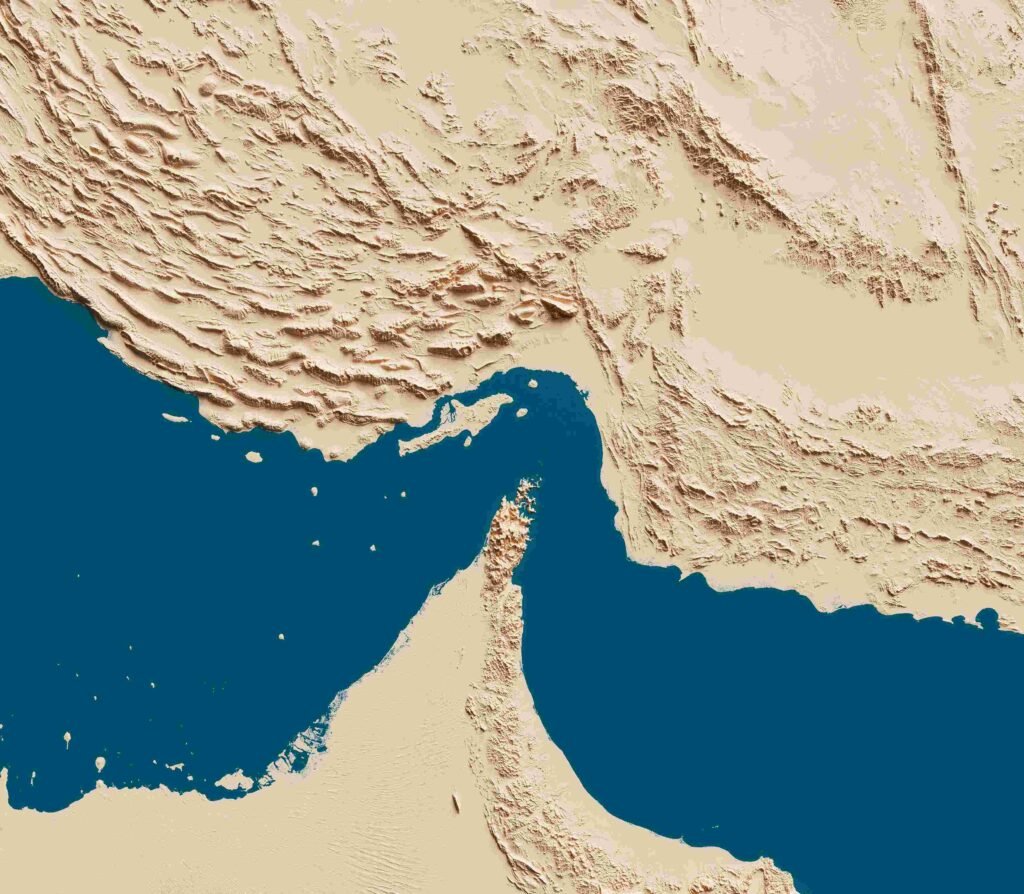
Iran and its regional allies responded by closing the Strait of Hormuz, disrupting global trade. The geographic significance of this action cannot be overstated.
The strait sits at the mouth of the Persian Gulf, connecting that body of water to the Gulf of Oman and the broader Arabian Sea. At its narrowest point, the passage measures roughly 33 kilometres across, with two navigable shipping lanes of approximately 3 kilometres each. Approximately 20% of global crude oil supply transits the strait under normal conditions, equivalent to 17–21 million barrels per day according to U.S. Energy Information Administration data.
The Supply Impact:
Global oil supply crashed by 10.1 mb/d in March, due to attacks on energy infrastructure and restrictions on tanker traffic in the Middle East. Global oil output is expected to fall by 6.9 mb/d (6.6 percent) year-on-year in 2026Q2, recording its largest quarterly decline since the COVID-19 pandemic.
This represents the most severe oil supply disruption since the 1979 Iranian Revolution and subsequent energy crisis.
Price Escalation and Market Volatility
Brent crude has surged from approximately $70 per barrel before the conflict to around $119, a move of nearly 70% in a matter of weeks.
Analyst projections suggest Dated Brent could approach $154 per barrel if the disruption extends to 12 weeks, driven by an estimated demand shortfall of 5.3 million barrels per day. Oil prices could reach US$200/bbl in worst-case scenario as more than 11 million b/d of Gulf crude and condensate supply remains curtailed.
The IEA Assessment:
The head of the IEA described the situation caused by the war as the "greatest global energy security challenge in history".
Global Economic Consequences
The energy shock is creating cascading economic damage across multiple regions.
Developed Economies:
A closure of the Strait of Hormuz that removes close to 20 percent of global oil supplies from the market during second quarter 2026 is expected to raise the average West Texas Intermediate (WTI) price of oil to $98 per barrel and lower global real GDP growth by an annualized 2.9 percentage points in second quarter 2026.
Global GDP growth slows from 3% in 2025 to 2.3% in 2026. The EU27 GDP declines by 1.5% in 2026 and 0.5% in 2027. US GDP growth would fall below 1% in both years, while China's GDP growth slows to 3% in 2026.
Regional Impact:
The regional economic impact would be severe and uneven. The Middle East could see GDP contract by 10.7% in 2026.
Agricultural and Commodity Shock:
Urea, a critical agricultural input, has risen 50% since the conflict began. This creates secondary humanitarian risk — reduced agricultural productivity threatens food security in vulnerable populations dependent on fertilizer-intensive farming.
Regional Power Dynamics: The Expanding Conflict
The israel iran conflict is not contained to Iran-Israel bilateral confrontation. It is reconfiguring the entire regional balance of power.
Hezbollah and the Lebanon Dimension
The conflict also saw the resumption of hostilities between Israel and Iran's close ally Hezbollah in Lebanon, which had been observing a fragile ceasefire since 2024.
Despite the ceasefire, which required the disarmament of Hezbollah and the withdrawal of the Israel Defense Forces (IDF) from southern Lebanon, Hezbollah had been seeking to restore its military capabilities and the IDF had continued to strike targets in southern Lebanon almost daily.
This reflects a fundamental dynamic: ceasefires in Middle Eastern conflicts often represent temporary tactical pauses rather than strategic resolution. The underlying incentives that drove conflict persist after ceasefire agreements, creating pressure for resumption.
The Houthis and Red Sea Dimension
The Houthis announced a Red Sea naval blockade of Israeli vessels. This extends the conflict into maritime commerce routes critical to global trade.
The Houthi blockade creates a secondary chokepoint beyond the Strait of Hormuz. Even if the Strait reopens, Israeli and allied shipping faces interdiction in the Red Sea, adding cost and risk to a critical global commerce route.
Arab State Positioning
The United Arab Emirates, Saudi Arabia, and Kuwait responded with their own strikes on Iran and its regional allies.
This positioning signals that Arab Gulf states perceive their interests as threatened by Iranian escalation. It also reveals that traditional US-Arab alliance partnerships remain functional despite broader geopolitical shifts.
NATO Involvement
NATO forces struck down Iranian drones and missiles near the Incirlik Air Base in Turkey (Türkiye).
Turkish involvement represents NATO's institutional response to the conflict. It signals that the conflict is no longer a regional Middle Eastern issue but has become one with direct implications for transatlantic security arrangements.
The Ceasefire's Fragility: Why Escalation Remains Likely
Unresolved Triggers Remain:
The core drivers of conflict have not been resolved. The attacks came when the Iranian regime was arguably at its weakest point for some years: There were extensive protests in Iran in early 2026, motivated by a weakened economy as well as struggling infrastructure, illustrating the regime's weakened legitimacy within the country.
This suggests that Iran's government faced domestic political pressure that may have motivated military confrontation as a nationalist rallying mechanism. If domestic instability remains, the incentive to resume external conflict persists.
Diplomatic Limits:
Despite President Trump's urging Israel not to retaliate, Israel subsequently hit targets in Iran, including a petrochemical plant, which could prompt Iran to once again target Gulf energy infrastructure.
This statement reveals a core problem: Trump administration efforts to manage escalation through diplomatic pressure on Israel have limited effectiveness. Netanyahu's government calculates its own strategic interests independently of U.S. preferences.
The Tit-for-Tat Dynamic:
Military escalation in the Middle East often follows a pattern: one side strikes, the other retaliates, and both claim victory and justification for future strikes. This cycle is self-perpetuating absent external diplomatic breakthrough.
Even after Iran and the United States announced a ceasefire on 8 April, ship traffic through the Strait of Hormuz remained far below pre-war levels. The return to normalcy has not occurred, suggesting that underlying mistrust remains.
International Response and Diplomatic Status
United Nations Position:
Multiple prominent international organizations, such as the United Nations, condemned the attacks on both countries and called for a restraint and Israel to de-escalate.
International Condemnation:
Several countries, such as China, Japan, Russia, and Turkey, condemned the Israeli attack on Iran and called for de-escalation.
Negotiation Framework:
Talks are being mediated by Pakistan. The choice of Pakistan as mediator rather than Qatar, Egypt, or traditional Middle Eastern powers reflects recognition that regional mediators lack credibility with all parties.
What Comes Next: Scenarios for the Remainder of 2026
Best Case Fragile Ceasefire Holds
If diplomatic pressure from the Trump administration and Pakistan-mediated talks produce agreement, the ceasefire could consolidate. Oil markets would stabilize toward $85-90 per barrel. Global GDP impact would be contained to 2-3 percentage points. This outcome is possible but not currently the expected trajectory based on June-July 2026 reporting.
Middle Scenario Periodic Escalation and De-escalation
Sporadic military strikes continue through late 2026. Oil remains disrupted. The Strait does not fully reopen. Humanitarian crisis expands. Global recession deepens. This scenario is what current evidence suggests is most likely.
Worst Case Full Conflict Resumption
If diplomatic talks fail and Israel or Iran launches major new strikes, the conflict expands. Oil could reach $150-200 per barrel. Global recession becomes severe. Middle Eastern GDP contracts 10%+. Regional humanitarian catastrophe grows exponentially.
Given the fragile ceasefire and ongoing military posturing, do you think the Israel-Iran conflict will escalate again before year-end 2026?
Related News

Oil price surge today

Germany AfD Election
Iran War

One Comment