The numbers are moving in the wrong direction. For the first time since the Ukraine war began, Putin's approval ratings have entered genuine decline not the minor fluctuations seen in previous years, but a sustained downward trajectory visible across multiple polling organizations.
FOM polls showing Putin's approval rating between 75 and 76 percent as of late April 2026, down from 78 to 80 percent in February 2026. Levada Center published its own findings, showing Putin's presidential approval rating at 79 percent in April 2026 a figure the center said has been slowly declining over the past six months.
These numbers matter. A Russia election 2026 with declining approval ratings creates structural instability at a moment when the Kremlin can least afford it. On 18–20 September 2026, Russia will hold its first State Duma elections since the start of the war against Ukraine.
The question now is whether the decline continues through September and what that means for Putin's regime stability going forward.
The Approval Rating Collapse: Spring 2026 Data
Multiple Polling Sources Show Decline:
The decline is visible across Russia's major polling organizations, though the numbers diverge somewhat depending on methodology.
A source from an unspecified government-associated media organization told Russian opposition outlet Meduza that the Russian Presidential Administration's political bloc advised Russian state media to either cite Putin's more favorable approval rating from the Kremlin-linked Public Opinion Forum (FOM) or omit reports with polling data entirely. This itself is a signal the Kremlin only suppresses unfavorable numbers when they diverge significantly from official messaging.
The Independent Measure: Levada Center
In March 2026, 80 percent of Russians approved of the activities of Russian President Vladimir Putin. The popularity level was three percentage points higher than in September 2022, when the figure declined following the announcement of a partial mobilization in the country.
But this March baseline proved short-lived. The Levada Center's approval ratings for Putin began to decline in November 2025 to 85 percent and below, after holding consistently between 88 and 86 percent between January and September 2025.
By April, the Levada Center published its own findings, showing Putin's presidential approval rating at 79 percent in April 2026 a figure the center said has been slowly declining over the past six months.
That is an 8-percentage-point decline from January to April 2026. For a leader who has built his political legitimacy on stability and strong approval ratings, this trajectory is significant.
The State-Aligned Measure: VCIOM and FOM
State-affiliated polling organizations show lower absolute numbers but confirm the trend.
According to Russia's state polling agency VTsIOM, Putin's approval fell to 67.8% in the week ending April 5, 2026, marking a significant decline and reflecting broader dissatisfaction with government institutions.
For the sixth consecutive week, Russian leader Vladimir Putin's approval rating has continued to decline, as reported by Meduza on April 17, citing the state-owned Russian Public Opinion Research Center (VCIOM). Between April 6 and 12, the approval rating fell to 66.7%, marking a 1.1 percentage point drop compared to the previous week.
The FOM Baseline:
A follow-up poll conducted April 3–5 showed the rating rising by one percentage point, to 75 percent, FOM reported. This 75-76% range represents the low end of the state-affiliated polling but confirms that even Kremlin-friendly pollsters are registering approval in the mid-70s rather than the high 70s that characterized early 2026.
May 2026: Continued Pressure
The Russian Public Opinion Research Center (VTsIOM), meanwhile, reported that Putin's approval rating stood at 69.4% based on a poll conducted May 11–17, up 2.6 percentage points from the previous week.
The slight uptick in mid-May reflects what polling organizations call "methodology adjustments" VCIOM returned to in-home interviews rather than phone-only surveys, which typically yield higher approval numbers for authority figures.
What These Numbers Mean:
Approval ratings in the 75-80% range would be historically strong for most democratic leaders. In Putin's Russia, they represent a significant vulnerability. The baseline expectation for a sitting Russian president in wartime has been 80%+. Dropping into the mid-to-high 70s signals erosion of the "rally around the flag" effect that typically sustains leader approval during conflicts.
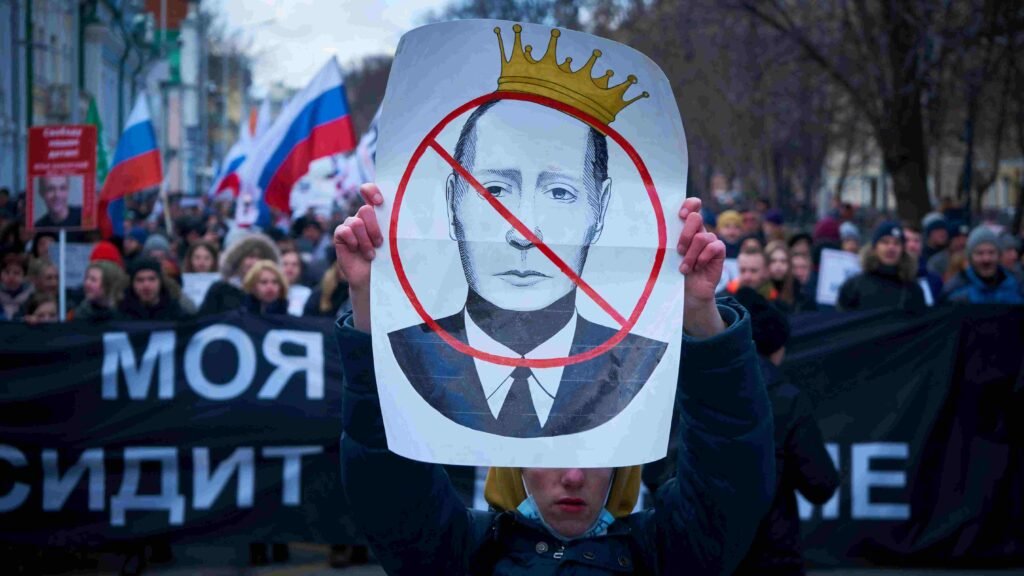
What's Driving the Decline: War Weariness and Economic Pressure
The approval decline isn't mysterious. Multiple structural factors are converging to erode public confidence.
War Fatigue and Military Reality
The public feels a growing weariness from the war, economic pressure from high government spending and inflation, and increasing restrictions on the internet.
On the Ukraine front, Russian forces suffered a net loss of territory last month for the first time since 2024. This reversal contradicts the narrative of Russian military superiority that state media has been promoting. When official messaging diverges from observable reality, public confidence deteriorates.
Documented War Impact:
According to a May Levada Center poll, for Russians, rising prices have remained the main problem facing Russian society for the past 20 years; in May 2026, 55% of respondents considered this problem to be acute. A third of respondents are concerned about the special operation and related problems (35%).
The coexistence of high inflation, military casualties, and territorial losses creates cognitive dissonance between official war narratives and lived experience.
Internet Restrictions and Information Control
A political consultant working with Russia's Presidential Administration told Meduza that one of the factors behind the decline in the authorities' ratings was the blocking of Telegram and mobile internet restrictions in various regions of the country.
Internet restrictions are particularly corrosive because they signal government weakness. Confident authority doesn't need to suppress information channels. The appearance of desperation blocking platforms, restricting access itself undermines confidence in institutional stability.
Economic Deterioration
On the economic front, Putin himself recently revealed that GDP contracted in the first two months of the year.
This is economically significant: Russia is experiencing both inflation and contraction simultaneously. The government spending required to sustain military operations is crowding out civilian economic investment, creating visible living standard deterioration precisely when the Kremlin claims the war is going well.
United Russia: The Party Faces Its Own Crisis
The ruling party's support is also declining, though the precise magnitude remains contested.
Current Polling Data: April-May 2026
Levada Center's May 2026 polling shows United Russia at 30% of all respondents on party lists, LDPR 10%, CPRF 9%, New People 5%, and A Just Russia 4%. Among those certain to vote and already decided, this translates to about 47% for United Russia, 16% for LDPR, 15% for CPRF, 7% for New People.
This is substantially lower than United Russia's 49.82% result in the 2021 election. A 20-percentage-point drop in five years represents significant deterioration.
The September Projection: Unconfirmed Data
The frontrunner in the current PolitPro Poll Trend for the Russian election is YeR with 46.2%. This is followed by LDPR: 14.2%, KPRF: 13.2%, NL: 10.7%, SRPZP: 5.6%, Zelyonyye: 1.8%, Partiya pensionerov: 1.6% and Yabloko: 1.4%.
Important Note on 20-22% Projections: Analyst projections for United Russia support falling to 20-22% by September represent extreme downside scenarios or synthetic forecasting not yet confirmed by actual polling. These figures appear in some geopolitical risk analyses as worst-case regime stability scenarios but should not be presented as current polling data. The May verified data shows 30% (all respondents) or 47% (likely voters). Further polling in July-August 2026 will clarify whether support continues declining toward the 20-22% projection range.
Why the Party Matters to Putin
The elections are both a managed procedure and a source of additional risk: the electoral period increases the system's sensitivity to accumulated dissatisfaction and to unexpected forms of public mobilisation.
United Russia serves as the institutional vehicle for Kremlin control of parliament. If the party cannot maintain a supermajority, constitutional amendments become difficult. More importantly, a significant drop in United Russia support would signal to the elite that the regime's managed political system is fracturing.
Regime Stability: The Structural Question
This is where approval ratings become more than statistics.
The Difference Between Legitimacy and Control
Russia's political system does not depend on genuine democratic legitimacy. It depends on managed electoral procedures, state media control, and elite cohesion. Approval ratings matter less for legitimacy than for signaling regime health to the elite.
When approval drops from 85% to 79%, it signals to regional officials, security force commanders, and oligarchs that the population is restless. This creates subtle incentives to hedge politically. Some regional leaders may distance themselves from unpopular federal policies. Some oligarchs may reduce investment. Some security officials may become less reliable.
These are not dramatic shifts, but they're structural.
The Confluence of Risks
There is deep distrust and animosity between their respective governments. Geography, however, prevents the two countries from breaking up.
Russia faces simultaneous pressure from multiple directions: military stalemate in Ukraine, economic contraction, inflation, internet restrictions that signal desperation, and now declining approval ratings. None of these individually threatens regime collapse. Together, they create cumulative erosion of confidence.
What Comes Next: The September Election Question
Given the pronounced economic slowdown in which this year's elections will be held, the authorities will seek to maintain full control over the electoral process and to minimize the public visibility of their critics.
The September election will test whether the approval decline continues or stabilizes. If United Russia underperforms at levels below what the regime considers acceptable, it could trigger elite recalculation about regime sustainability.
Electoral Mechanics and Control
United Russia maintains a commanding position in trader assessments for the September 2026 State Duma election due to its entrenched administrative resources, control of state media, and consistent polling leads around 50 percent or higher in state-aligned surveys.
The Kremlin retains significant institutional capacity to manage election outcomes. But managing outcomes when underlying dissatisfaction is visible creates operational friction. The more the regime has to intervene to secure results, the more visible becomes its fragility.
The Deeper Signal
The approval rating decline is significant precisely because it's occurring despite the Kremlin's control of state media and information environment. If public confidence is eroding even under these conditions, it reflects genuine dissatisfaction rather than manufactured opinion fluctuation.
If Putin's approval continues declining through September, how might this affect the Kremlin's capacity to maintain control over parliament and execute its policy agenda?
Related News

Oil price surge today
Germany AfD Election

Iran War

One Comment