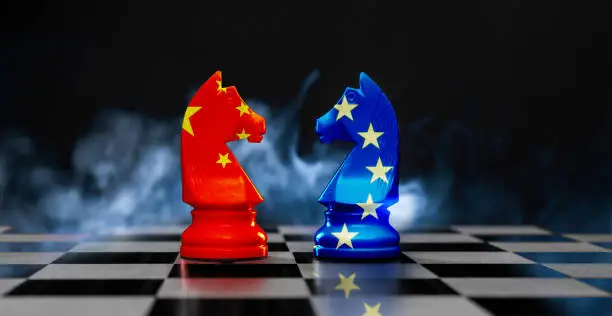
The European Union does not move quickly. It deliberates, consults, hedges, and negotiates often for years before arriving at a decision that its member states can collectively stomach. That is precisely why Brussels’ decision to impose additional tariffs on Chinese electric vehicles, reaching up to 45 percent on top of existing duties, carried unusual weight. It was not an impulsive reaction. It was a considered institutional signal. And Beijing understood it as one.
The china eu trade war did not begin with electric vehicles. But the EV tariff decision, finalized in late 2024 after a year-long anti-subsidy investigation by the European Commission, brought a slow-burning structural conflict into sharp relief. What looks on the surface like a trade dispute over cars is, at its core, a confrontation about industrial strategy, state capitalism, and the limits of market access in a world where economic interdependence no longer guarantees political alignment.
Why Europe Moved and Why Now
The European Commission’s investigation concluded that Chinese electric vehicle manufacturers BYD, SAIC, and Geely among the most prominent benefit from a web of state subsidies that allow them to price their products well below what European competitors can match. Commission President Ursula von der Leyen framed it explicitly in market-fairness terms: the global market, she argued, was being flooded with cheaper Chinese EVs made possible by enormous state support.
That framing matters. The EU has long maintained that its trade enforcement actions are WTO-consistent, rule-based responses to unfair practices rather than protectionism dressed up in legal language. Whether that distinction holds analytically is debatable. What is not debatable is the underlying industrial pressure. European automakers — Volkswagen, Stellantis, Renault are watching their domestic market shares erode at precisely the moment they are navigating the most expensive industrial transition in their history. The political economy inside Europe made inaction increasingly untenable.
Chinese overcapacity is the structural engine beneath all of this. Beijing’s industrial policy has directed capital at scale into electric vehicles, batteries, and green technology, producing export volumes that the domestic Chinese market cannot fully absorb. That surplus production flows outward. Europe, with its large consumer base and relatively open market, became a primary destination.
Beijing's Response: Measured, Then Pointed
China’s initial response was calibrated formal complaints to the WTO, diplomatic protests through official channels, and offers of negotiated minimum price commitments as an alternative to tariffs. That is standard playbook. What followed was less standard.
Beijing initiated its own trade investigations into European products: brandy, dairy, pork. The targets were not random. French cognac exports, Spanish pork, Dutch dairy these are products tied to politically sensitive constituencies inside EU member states that have historically favored accommodative positions toward China. The message was clear without needing to be explicit: eu china tariffs will have a price, and that price will be distributed across Europe unevenly.
This is where the institutional complexity of the EU becomes strategically relevant. China does not need to convince Brussels. It needs to fracture the coalition of 27 member states that gives Brussels its mandate. Germany, with its deep automotive and industrial exposure to the Chinese market, has been the most openly reluctant participant in the tariff push. BMW and Mercedes-Benz both lobbied against the measures a notable divergence from the position of their French competitors, who stood to gain more from Chinese EV restrictions than they stood to lose.
The Asymmetry at the Heart of Bilateral Trade
Europe China trade tensions have deepened partly because the bilateral trade relationship was never as symmetrical as the headline numbers suggested. The EU exported roughly €230 billion in goods to China in 2023 while importing close to €550 billion a trade deficit of over €300 billion, according to European Commission data. That imbalance has widened consistently over the past decade, driven by Chinese manufacturing competitiveness and, increasingly, by industrial policy designed explicitly to dominate export categories that Europe once led.
The electric vehicle sector is the most visible example, but it is not the only one. Solar panels, wind turbine components, and battery technology all follow similar trajectories. European manufacturers are not simply losing a price competition they are competing against state-backed industrial programs operating with a different set of incentives, timelines, and loss tolerances than any private firm can match.
That is the deeper argument behind the tariff decision. It is not primarily about protecting legacy automakers. It is about whether Europe’s green industrial transition heavily subsidized through the Green Deal and the Net-Zero Industry Act can develop domestic manufacturing capacity before Chinese competitors entrench themselves so deeply in the supply chain that European strategic autonomy in clean energy becomes structurally compromised.
What the Tariffs Actually Do and Don't Do
It is worth being precise about what eu china tariffs of this scale can realistically achieve. They raise the cost of Chinese EVs in the European market, creating space for European manufacturers to compete on price. They signal to Chinese producers that market access in Europe is conditional, not guaranteed. And they create a negotiating lever one that Brussels can theoretically trade away in exchange for investment commitments, supply chain partnerships, or minimum pricing agreements.
What the tariffs do not do is resolve the underlying structural problem. Chinese manufacturing capacity in EVs is not going to contract because of European trade barriers. It will redirect toward Southeast Asia, the Middle East, Latin America, and Africa. Some of that redirection was already underway before the tariff decision. BYD’s investments in manufacturing facilities in Hungary and Turkey are partly a hedge against exactly this kind of market access disruption.
There is also the question of economic sanctions-style retaliation risk. China’s countermeasures against European agricultural products were targeted and limited. A more aggressive Chinese response restrictions on rare earth exports, technology licensing, or market access for European financial services in China would escalate costs significantly for both sides. Neither party has an obvious interest in that scenario, but the escalation pathway exists.
Germany's Position and the Internal EU Fracture
No analysis of europe china trade tensions is complete without accounting for Germany’s structural dilemma. German industry’s exposure to China is qualitatively different from France’s or Italy’s. Volkswagen generates roughly a third of its global revenue in China. BASF has made multi-billion euro investments in Chinese chemical production facilities. German machinery and industrial equipment exports to China dwarf those of any other EU member.
Berlin’s reluctance to endorse aggressive trade measures against Beijing is not ideological. It is arithmetical. The German government spent years resisting EU-level tariff action, ultimately abstaining rather than voting against the final measure a diplomatic posture that allowed the tariffs to pass while maintaining a degree of political distance from the decision
That internal fracture is not incidental to the china eu trade war it is central to it. Beijing’s strategic calculation has consistently been that European unity on trade enforcement is fragile. The EV tariff decision tests that calculation. If Germany continues to act as a moderating force, and if Chinese investment in EU-based manufacturing grows as a tariff-avoidance strategy, the practical impact of Brussels’ measures may be considerably more limited than the headline rates suggest.
The Longer Strategic Question
Step back from the immediate dispute and a larger question comes into focus: what kind of economic relationship is Europe actually trying to build with China?
The EU’s official position “de-risking, not decoupling” is an attempt to thread a needle between Washington’s more confrontational posture and the commercial realities of European industry’s China exposure. It acknowledges strategic risk without committing to the kind of structural separation that would impose severe short-term economic costs. Whether that middle position is strategically coherent over a ten-year horizon is genuinely uncertain.
China’s economy is slowing, its property sector remains under stress, and domestic consumption has not expanded to replace the export-driven growth model at the pace Beijing’s planners anticipated. That changes the calculus slightly a China with slower growth and structural overcapacity in key industries is a China with stronger incentives to push exports, not fewer. European markets will remain attractive precisely because they are large, wealthy, and compared to the United States relatively accessible.
The tariff decision does not resolve that dynamic. It manages it, imperfectly, for now. The deeper work building European industrial capacity in batteries and clean technology, reducing critical supply chain dependencies on Chinese inputs, and constructing a coherent EU-level industrial strategy that can survive changes in government across 27 member states is a decade-long project that trade tariffs alone cannot deliver.
Brussels has drawn a line. Whether it holds, and at what cost, is the real story still unfolding.