Trump AI image controversy 2026
Tuesday, April 14, 2026 Trusted by millions worldwide Back to News Politics Trump AI image controversy 2026 : ‘I Thought...
Read More → 
Tuesday, April 14, 2026
Trusted by millions worldwide
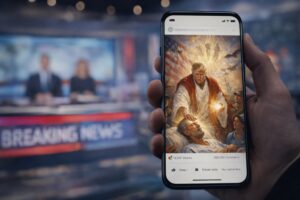
Trump AI image controversy 2026 on Truth Social on April 13. The image showed him in white robes with light emanating from his hands over a patient. The post was deleted Monday afternoon. Trump claimed it depicted a doctor, not a religious figure.Backlash came from conservative Christian commentators, the Vatican, and international leaders.
An AI-generated image posted by President Donald Trump on Truth Social on April 13, 2026 triggered a swift and significant backlash. The image showed Trump in white flowing robes, leaning over a patient in a bed. Light radiated from his hands toward the person lying below him. Within hours, the post became one of the most discussed pieces of political media content of the year. The controversy has since been described by observers as a defining moment in the ongoing debate over AI imagery, religious symbolism, and political communication.
The post was deleted on Monday afternoon, according to screenshots archived by Reuters. However, the damage to the news cycle was already done. The image had been screenshotted and shared millions of times across every major social media platform.
At an impromptu press briefing on Monday, Trump offered his account of the image.
‘I looked at the image and I saw a man in white,’ he told reporters. ‘I thought I was a doctor or maybe a Red Cross worker helping a person in need. It was about health care.’
He described the white robes as medical scrubs. He said the light from his hands was ‘good lighting’ or possibly a ‘medical laser.’ He insisted the image had nothing to do with religion.
Trump did not stop at the explanation. He pushed back hard at the press.
He accused journalists of intentionally framing the image as messianic. He called the religious interpretation a ‘coordinated hit piece.’ He said his supporters understood the true meaning healthcare, not religion.
That argument was tested immediately. Several of his own evangelical supporters were among the first voices online calling for the post to be removed. The claim that only the media saw religious symbolism proved difficult to sustain.
The sharpest criticism came from an unexpected corner. Conservative commentator Megan Basham, writing on X, said she supports many of Trump’s policies but called the image ‘a step too far.’ She said using Christ-like imagery for political purposes crossed a clear line for many Christian voters.
Sports commentator and conservative activist Riley Gaines was more direct. ‘Faith is sacred,‘ she wrote. ‘It should not be a social media prop. This is gross disrespect to millions of believers.’ Other prominent evangelical figures expressed similar concern. The consensus among many in the Christian right was that the image did not read as a healthcare image. It read as something else entirely.
Vice President JD Vance was asked for his reaction later in the day.
Vance described Trump as someone who enjoys being ‘provocative’ on social media. He urged people not to interpret the post literally. He said the President was ‘just mixing it up’ and that the media was over-reading the symbolism.
The response was measured and careful. But it did not significantly reduce the backlash. By Monday evening, the criticism from within the Republican coalition had not abated.
The timing of the image could hardly have been worse.
It appeared less than a week after a public exchange between Trump and Pope Leo XIV. The Pope had criticised the administration’s stance on international military strikes. He called for mercy and restraint. Trump responded publicly, describing the Pope as ‘soft on crime’ and ‘out of touch.’

The Vatican issued a statement following the image post. The Holy See said that ‘sacred symbols belong to the faithful, not to political campaigns.’ The statement did not name Trump by name. The meaning was not ambiguous.
The post landed near Orthodox Easter.
For hundreds of millions of Orthodox Christians in Eastern Europe, the Middle East, Russia, and North Africa, this period is among the most sacred in the calendar year. Several international leaders expressed concern that the image was deliberately provocative.
Diplomatic sources in Brussels and Ankara told Reuters the image had complicated ongoing conversations about American soft power in regions already destabilised by the US-Iran conflict. The image was being shared widely in Eastern European media with coverage framing it as evidence of American political irreverence toward religion.
Art historians and visual culture analysts spent April 13 examining the image closely.
Dr. Marcus Linfield, a visual culture researcher at the University of Edinburgh who commented on the image for the Guardian, said the robes bore no resemblance to medical scrubs. ‘The garment is floor-length, seamless, and white a classic iconographic choice in Western Christian art representing purity and divinity,’ he said.
The light pattern emanating from the hands was also analysed. Linfield noted that the shape and diffusion of the light closely matched the halo-style radiance seen in Renaissance depictions of healing miracles. ‘A medical laser would produce a precise, directed beam,’ he said. ‘This is something else entirely.’
Experts also noted that the overall composition a standing, luminous central figure bending over a supine, clearly suffering individual is a direct visual reference to dozens of canonical healing images in the Christian tradition.
This is not the first time Trump’s social media accounts have circulated AI-generated religious imagery.
Previous posts, documented by media tracking organisations including the AP and the Washington Post, have shown Trump alongside religious figures in implied positions of alignment or blessing. These images circulate widely among certain supporter communities where the ‘divine appointment’ narrative has currency.
Critics argue these images are not accidental. They say the imagery is a deliberate visual communication strategy aimed at reinforcing specific beliefs about Trump’s singular political role. Supporters counter that the images are humorous, not sincere theological statements.
The April 13 image has intensified that debate. Even those who previously dismissed the imagery as harmless online culture say this one went further than anything posted before.
The post was deleted. The briefing happened. The news cycle will move on.
But the episode leaves a specific residue. It has given critics within the Republican coalition a concrete example they can reference when arguing that certain lines of political communication carry real costs. The evangelical voter bloc which remains one of the most reliable components of the Republican electoral coalition showed on April 13 that it has limits it will defend publicly.
History suggests that Trump has significant political resilience with religious voters. He has survived many controversies that analysts predicted would damage his standing with that community.
The calculation is different here. The objection is not ideological it is theological. When conservative Christian commentators call something ‘gross disrespect’ to their faith, they are not making a policy argument. They are making a statement about identity and values.Whether Monday’s episode registers as a lasting data point or fades into the general noise of 2026 politics will likely depend on whether the image resurfaces in future political advertising and whether any opponent is prepared to make it a sustained campaign theme.
For now, the President says he was a doctor. Most of those who saw the image disagree.