OpenAI vs Big Tech 2026
Monday , Aprail 14, 2026 Trusted by millions worldwide Back to News Polotics OpenAI Big Tech Competition 2026: AI Tools...
Read More → 
Monday , Aprail 14, 2026
Trusted by millions worldwide
OpenAI vs Big Tech 2026 One of the most significant strategic developments in the OpenAI vs Big Tech dynamic of 2026 is that product quality — while still important is no longer the primary competitive advantage. Distribution is.
OpenAI vs Big Tech 2026 The rivalry between OpenAI and Big Tech has entered a new phase in 2026 and it’s more consequential than anything the industry has seen before. What began as a race to build the smartest chatbot has evolved into a fierce battle for AI platform dominance, with Google, Microsoft, Apple, Meta, and OpenAI each fighting to become the default intelligence layer of the modern internet.
As of April 2026, the OpenAI vs Big Tech competition is no longer measured in model benchmarks alone. It is being fought in smartphone operating systems, enterprise productivity suites, cloud infrastructure contracts, and now personal AI agents that can plan your day, write your emails, and execute multi-step digital tasks autonomously.
This is the story of how that war is unfolding.
In 2023 and 2024, the AI race was largely defined by chatbot releases — ChatGPT, Gemini, Copilot, and Claude all competed for user attention through conversational interfaces. By 2025, the focus shifted to multimodal capabilities: models that could process images, audio, and documents alongside text.
But 2026 marks a fundamentally new chapter: the age of agentic AI.
Agentic AI refers to systems that don’t just respond to prompts they take action. These tools can browse the web, fill out forms, schedule meetings, write and run code, and coordinate complex workflows across multiple apps without constant human input. The shift from “AI as assistant” to “AI as operator” is redefining what companies are actually competing for.

One of the most significant strategic developments in the OpenAI vs Big Tech dynamic of 2026 is that product quality while still important is no longer the primary competitive advantage. Distribution is.
Google, Apple, and Microsoft hold what analysts call the “native advantage”: their AI is already installed on billions of devices, embedded in the apps people use every day, and accessible without an additional subscription or download. For OpenAI, which does not own an operating system or a major consumer device platform, this is a structural challenge that no model improvement can fully overcome.
Rather than compete on hardware or OS integration, OpenAI has doubled down on a developer and enterprise ecosystem strategy. The company has aggressively expanded its API access, built out a marketplace of custom GPT agents, and forged deep integration deals with companies like Salesforce, SAP, and multiple healthcare providers.
The goal is to become the “intelligence layer” that sits inside other platforms a strategy that has drawn comparisons to how AWS became the infrastructure backbone of the internet even without owning consumer-facing products.
Whether this approach can withstand the native-distribution advantages of Big Tech remains the central tension of the 2026 AI landscape.
No single company is dominating the AI platform war in April 2026. Each major player holds real advantages in specific domains: Google in search and mobile, Microsoft in enterprise, Apple in privacy and hardware integration, Meta in open-source and social distribution, and OpenAI in developer mindshare and model reputation.
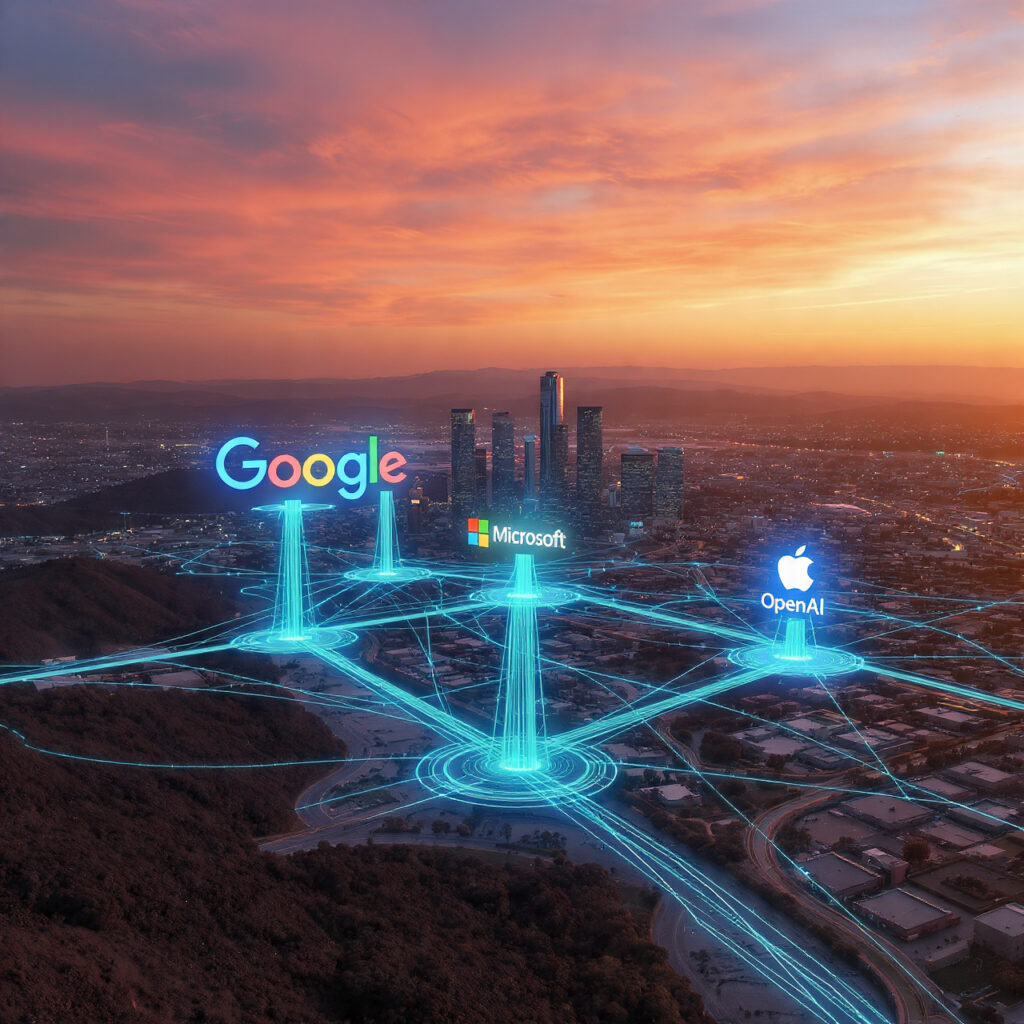
Beneath the visible product competition, a quieter but equally important war is being waged in data centers and privacy regulations.
The cost of running large AI models what the industry calls inference costs has become a critical competitive variable. Companies that can serve AI responses faster and cheaper gain a direct advantage in user retention and enterprise contract pricing.
Apple and Samsung’s on-device AI strategy directly addresses this by eliminating server round-trips for many common tasks. Google and Microsoft counter with their massive cloud infrastructure investments. OpenAI relies on its partnership with Microsoft Azure for compute, a dependency that some analysts see as both a strength and a vulnerability.
For international markets and government customers, data sovereignty has become a key purchasing factor. Several European and Asian enterprises have moved AI workloads to regional cloud providers specifically to avoid storing sensitive data on US-based infrastructure a trend that all major AI players are being forced to address.
The AI platform rivalry of 2026 isn’t a two-player game. Two major challengers are disrupting the established order.
Elon Musk’s xAI and its Grok model has gained significant traction through its deep integration with X (formerly Twitter), giving it a unique real-time data advantage and a built-in distribution channel of over 500 million active users. Grok 3, released in early 2026, demonstrated competitive performance on several industry benchmarks.
Meanwhile, Meta’s decision to release the Llama 4 model family under an open-source license has fundamentally altered the competitive dynamics of the industry. Businesses can now run highly capable AI models on their own servers, eliminating API costs and data-sharing concerns. This has been particularly significant for mid-sized enterprises that were previously priced out of advanced AI capabilities.
The open-source movement once considered a niche academic interest is now one of the most disruptive forces in the AI platform competition.

For everyday users, the AI platform war of 2026 has delivered meaningful benefits: faster, smarter, and more integrated AI tools across virtually every digital touchpoint. The challenge is that increased competition has also created fragmentation users may need different AI subscriptions or accounts depending on which platform they’re on.
For businesses, the sheer pace of change has made AI procurement a strategic board-level decision. Choosing a primary AI platform now carries long-term vendor lock-in implications comparable to selecting an ERP system a decade ago.
For developers, the proliferation of capable APIs and open-source models has lowered the barrier to building AI-powered products, even as the major platforms compete to capture the most promising startups within their ecosystems.
The OpenAI Big Tech Rivalry 2026 represents the final stage of the digital revolution. The AI tools competition across platforms proves that AI is no longer a feature it is the fabric of the modern economy. As the generative AI platform rivalry continues to mature, the winners will be those who can offer “Reliability” and “Context” over “Novelty.” On this April 13, 2026, the AI innovation race stands as a testament to the belief that the company that controls the “World’s Brain” will control the world’s markets.