US-China tariff 2026
Friday, Aprail 10, 2026 Trusted by millions worldwide Back to News Polotics US-China Trade Clash 2026: New Tariff Threats Shake...
Read More → 

Friday, Aprail 10, 2026
Trusted by millions worldwide
US-China tariff 2026 The White House stated that the tariffs are a response to what it describes as “unfair trade practices” by China, including state subsidies that allow Chinese manufacturers to undercut global competitors on price.
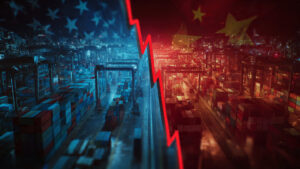
US-China tariff 2026 The US-China tariff dispute of 2026 has taken a dramatic turn. On April 10, 2026, the United States officially implemented a 145% tariff on a wide range of Chinese exports, including advanced semiconductors, electric vehicles (EVs), and solar energy components. The move represents the most aggressive trade action taken between the two countries in decades and has sent shockwaves through financial markets worldwide.
Unlike previous rounds of tariff escalation which targeted broad categories of consumer goods this new measure is highly targeted. Washington has focused specifically on China’s most competitive export sectors: clean technology and high-end electronics. Trade economists say the strategy is designed not to raise revenue, but to structurally limit China’s access to Western markets in these industries.
The tariff announcement follows a prolonged breakdown in bilateral trade talks. Officials from both sides had been meeting throughout late 2025, but negotiations stalled over disagreements on intellectual property protections, export subsidies, and technology transfer requirements.
The White House stated that the tariffs are a response to what it describes as “unfair trade practices” by China, including state subsidies that allow Chinese manufacturers to undercut global competitors on price. In particular, US officials pointed to China’s rapid expansion in the EV market, where domestic companies like BYD and CATL have significantly grown their international footprint.
These sectors were specifically chosen because they sit at the heart of both countries’ long-term economic strategies particularly in the global race to dominate clean energy and next-generation computing.

Beijing did not wait long to respond. Within hours of Washington’s announcement, China’s Ministry of Commerce announced sweeping export restrictions on rare earth elements a category of minerals critical to the production of electronics, defense equipment, and EV batteries.
China controls an estimated 60% of global rare earth mining and over 85% of processing capacity, according to data from the US Geological Survey. The export restrictions are widely seen as a direct counter-pressure tool, one that could disrupt US and European manufacturers who depend heavily on these materials.
“This is a tit-for-tat escalation that both sides appear willing to sustain for now,” said one trade analyst at a leading economic research firm. “The real question is how long domestic industries on both sides can absorb the cost.”
Financial markets responded swiftly to the news. On April 10, 2026, stock indices in Asia, Europe, and the Americas all recorded significant declines. Technology and industrial sectors were hit hardest, as investors weighed the long-term impact on supply chains and corporate earnings.
Analysts at major financial institutions noted that global markets had already been pricing in some level of trade tension, but the 145% tariff rate exceeded most forecasts and triggered a broader risk-off sentiment among institutional investors.

One of the most immediate concerns raised by industry groups is the potential for widespread supply chain disruption. Many multinational companies particularly in the electronics and automotive sectors have built their production models around affordable Chinese components.
A 145% tariff effectively makes Chinese-sourced inputs uncompetitive for US-bound production. Companies now face a difficult choice: absorb the increased costs, pass them on to consumers through higher prices, or urgently seek alternative suppliers in countries like Vietnam, India, or Mexico.
Industry groups representing US electronics manufacturers warned that the transition cannot happen overnight. Establishing new supplier relationships, meeting quality standards, and scaling up production elsewhere typically takes 18 to 36 months a timeline that does little to ease the near-term pain
The tariff escalation is not occurring in isolation. It follows a period of increasing maritime tensions in the South China Sea, the collapse of a planned bilateral dialogue earlier in 2026, and growing bipartisan consensus in Washington that economic dependence on China poses a national security risk.
The World Trade Organization (WTO) has acknowledged the dispute but has limited authority to intervene quickly. WTO dispute resolution processes can take years, making them ineffective in addressing fast-moving trade conflicts of this scale.
Meanwhile, US allies in Europe and Asia are watching closely. The European Union has so far maintained a more measured approach toward China trade policy but faces pressure from Washington to align more closely. Japan and South Korea, both deeply integrated into US-China supply chains, have expressed concern over the potential spillover effects.

Despite the severity of the current measures, most analysts believe some form of negotiation will eventually resume. Both the US and Chinese economies have significant exposure to the other. American consumers will feel tariff-driven price increases on a wide range of goods, while Chinese exporters face losing access to one of the world’s largest consumer markets.
However, the near-term outlook is for continued escalation rather than de-escalation. Neither government appears ready to make concessions ahead of domestic political considerations on both sides. In the US, the administration faces pressure from industrial lobbies backing the tariffs, while Beijing cannot be seen domestically as backing down under economic coercion.
For now, the 145% tariff on Chinese goods stands as a defining moment in the ongoing US-China economic rivalry a clear signal that the era of relatively open trade between the two superpowers has fundamentally changed.
The US-China tariff escalation of April 2026 is more than a trade dispute it is a structural shift in how the world’s two largest economies relate to each other. The 145% tariff on Chinese semiconductors, EVs, and green technology products will have real consequences: higher prices for consumers, disrupted supply chains for businesses, and a more fragmented global economy.
For investors, businesses, and policymakers, staying informed on developments in this rapidly evolving situation is not optional it is essential. The next few months will likely determine whether this dispute deepens further or whether both sides find a path toward managed competition.


 Optimized by Seraphinite Accelerator