
playstation plus june 2026 games
Thursday, May 20, 2026 Trusted by millions worldwide Back to News Tech PlayStation Plus Subscribers Are About to Lose Another...
Read More → Saturday, May 9, 2026
Trusted by millions worldwide
By Ali Aslam
The South China Sea crisis has never been a quiet place. But in 2026, it has become something more serious than a recurring flashpoint. It has become the defining theater of a geopolitical contest that is reshaping alliances, redrawing red lines, and testing the limits of international law in real time.
China is not backing down. And for the first time in years, neither is anyone else.
The pattern of Chinese behavior in the South China Sea has been consistent for more than a decade. Build. Militarize. Assert. When challenged diplomatically, reject. When challenged legally, ignore. What has changed in 2026 is the response from the other side.
The Philippines has firmly rejected renewed Chinese sovereignty assertions over the South China Sea, deepening a long-running dispute that has increasingly come to define regional security dynamics. Manila pushed back against claims tied to the Scarborough Shoal, insisting on legally grounded sovereignty over the feature and other holdings in the Spratly Islands. Modern Diplomacy
This is not a new argument. What is new is the tone and the backing behind it.
Satellite imagery shows that Chinese vessels have erected a floating barrier at the entrance to Scarborough Shoal — a disputed fishing reef sitting entirely within the Philippines’ exclusive economic zone. The deployment restricts Filipino access to waters their fishermen have used for generations, while China’s coast guard and maritime militia vessels continue to harass Philippine boats and disrupt fishing activity. FDD
This is the kind of incremental pressure Beijing has mastered. No single act triggers a military response. But each step, taken together, shifts the reality on the water.
Beijing has refined a playbook that operates just below the threshold of open armed conflict. The term used by analysts is “gray-zone tactics” a deliberate combination of coast guard deployments, maritime militia operations, infrastructure construction, and administrative declarations that collectively assert control without firing a single official shot.
China’s actions reflect a broader pattern: using gray-zone tactics to assert operational control over contested waters while remaining below the threshold for armed conflict and limiting the risk of a direct US response. These incremental steps, while individually limited, cumulatively shift the status quo in Beijing’s favor. FDD
The Scarborough Shoal encapsulates the entire crisis in miniature. In 2016, the Permanent Court of Arbitration ruled decisively in the Philippines’ favor, declaring China’s sweeping nine-dash line claims had no legal basis under the United Nations Convention on the Law of the Sea. Beijing simply ignored the ruling.
The Scarborough Shoal dispute illustrates the limits of legal rulings in the absence of enforcement mechanisms. The Philippines holds a favorable international judgment, but China’s control on the ground has not changed. This creates a structural imbalance where law and power operate on entirely parallel tracks. Modern Diplomacy
That gap between legal victory and physical reality is where the crisis lives.
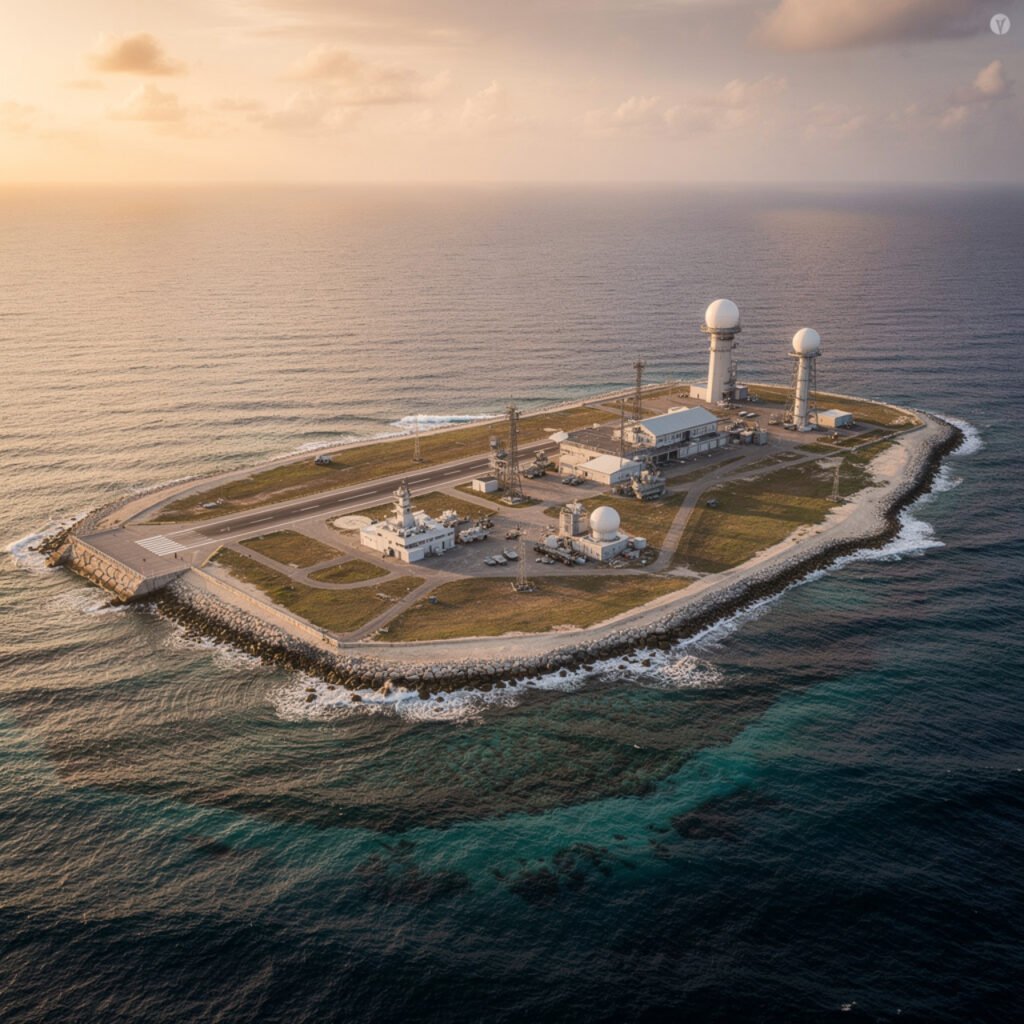
The incidents in 2026 have been both petty and pointed. China’s coast guard fired flares at Philippine aircraft over disputed Mischief and Subi reefs in the Spratly Islands in April 2026, while the Philippine National Maritime Council condemned at least five separate incidents of “aggressive and dangerous actions” by Chinese maritime forces against Philippine vessels and aircraft in the preceding weeks alone. Crisis Group
Beijing and Manila have also traded accusations over a Chinese research vessel operating near a disputed reef in the Spratly Islands, with each side warning of further countermeasures a sign of how even routine maritime activities have become flashpoints in this deepening dispute. South China Morning Post
What distinguishes 2026 from previous years is the breadth and coordination of the pushback. This is no longer a bilateral Philippines-China dispute. It has become a multilateral contest for the rules governing an entire ocean.
The United States, Australia, and the Philippines held the second trilateral maritime exercise of 2026 in the South China Sea from April 9 to 12, deploying warships, fighter jets, and surveillance aircraft. China’s Southern Theatre Command immediately announced a concurrent patrol and accused Manila of “co-opting countries outside the region.” Crisis Group
That accusation from Beijing tells its own story. China views the growing alliance network as an encirclement. Its partners view it as a proportional response to years of unilateral pressure.
The trilateral exercise was followed by the annual Balikatan exercise with the United States, launched on April 20 larger than the 2025 iteration and involving Australia, Japan, Canada, France, and New Zealand. Crisis Group
Six nations conducting joint military operations in disputed waters. That is not a routine exercise. That is a message.
Washington’s approach to the South China Sea has shifted from diplomatic engagement toward sustained military presence backed by alliance reinforcement.
Beginning in April 2024, the United States has completed 11 multilateral maritime cooperative activities with Australia, Japan, Canada, the Philippines, and New Zealand in the South China Sea, demonstrating a commitment to strengthen regional and international cooperation in support of a free and open Indo-Pacific. U.S. Department of State
The legal foundation for this posture is unambiguous. Unlawful maritime claims in the South China Sea pose a serious threat to freedom of navigation and overflight, free trade and unimpeded commerce, and freedom of economic opportunity for South China Sea littoral nations, according to the US State Department. U.S. Department of State
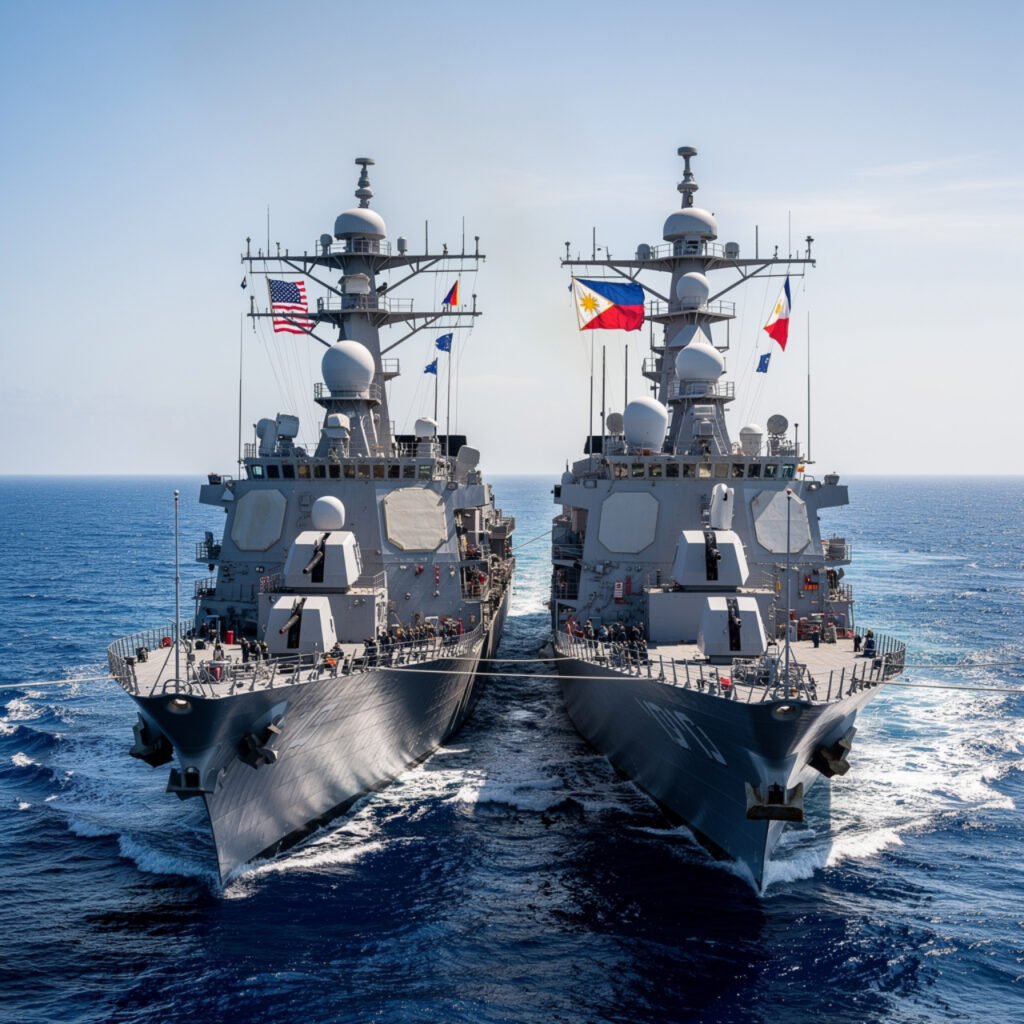
While the Philippines has led the most visible resistance, Vietnam has been methodically strengthening its own position.
Vietnam is expected to complete its infrastructure program in the Spratly Islands in 2026 and populate those positions with a mix of civilians and naval infantry a move that would see more frequent transit of supply ships and aircraft and could provoke a direct challenge from Chinese forces. East Asia Forum
Hanoi’s approach is quieter than Manila’s but no less consequential. Vietnam is building facts on the water, the same way China has for years.
The Association of Southeast Asian Nations has long struggled to respond cohesively to Chinese pressure, partly because Beijing has skillfully cultivated bilateral relationships with individual members to prevent collective action.
In 2026, with the Philippines holding the ASEAN chairmanship, there is a meaningful push to change that dynamic.
Philippine Foreign Secretary Maria Theresa Lazaro announced that Manila wants to conclude negotiations on a South China Sea code of conduct between ASEAN and China before the end of 2026, with an ASEAN working group scheduled to hold monthly meetings to accelerate the process. Foreign Policy
ASEAN leaders at the 48th Summit in Cebu adopted a sweeping declaration on maritime cooperation that reaffirmed the bloc’s commitment to freedom of navigation, maritime security, and international law, while backing the establishment of an ASEAN Maritime Centre in the Philippines. Daily Tribune
This is a more unified posture than ASEAN has demonstrated in years. But the structural obstacles remain formidable.
Manila will not approve a weak or non-binding code of conduct that could entrench China’s presence in the West Philippine Sea, while Beijing is unlikely to agree to any agreement that is legally binding or restricts its coast guard activities. East Asia Forum
Those are two positions with no obvious middle ground.
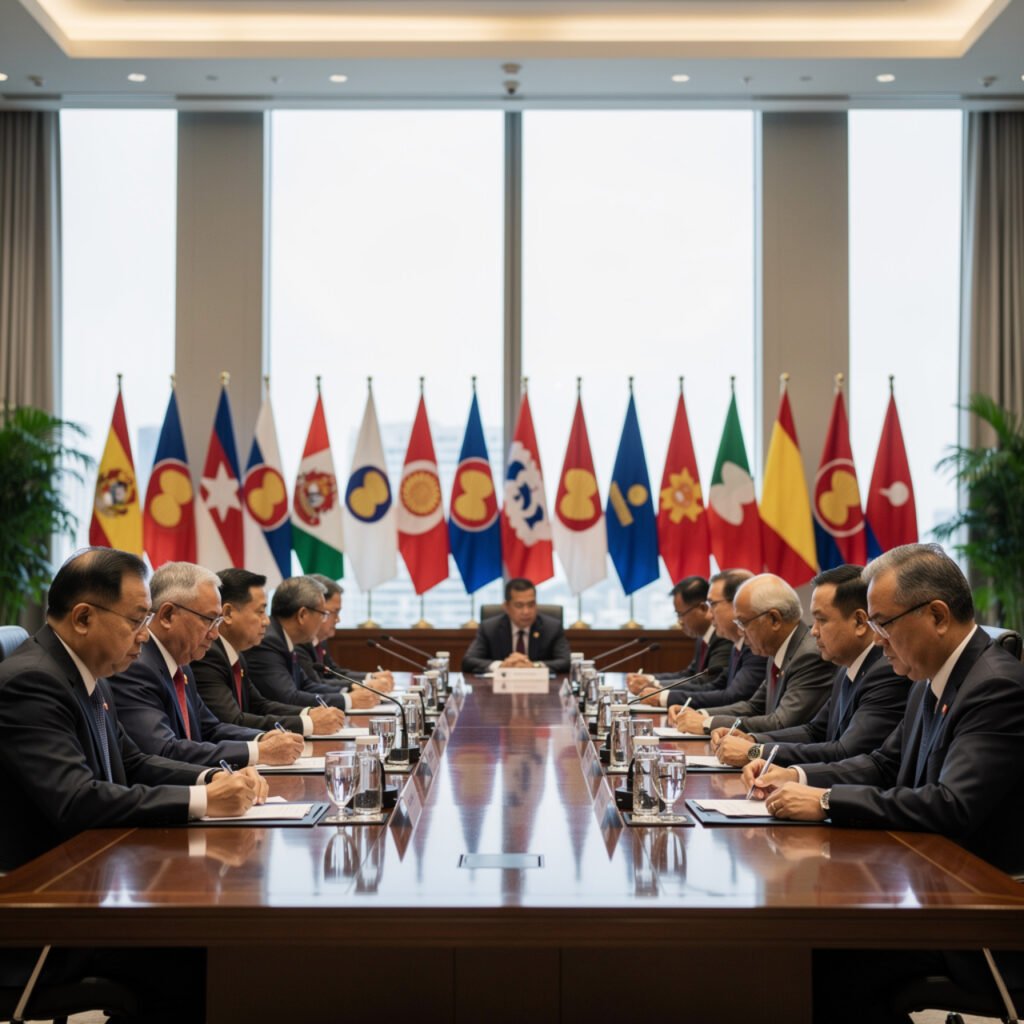
The South China Sea crisis is not just a regional security problem. It is a global economic one.
China’s sweeping sovereignty claims over the sea which sits atop an estimated 11 billion barrels of untapped oil and 190 trillion cubic feet of natural gas have antagonized Brunei, Indonesia, Malaysia, the Philippines, Taiwan, and Vietnam. The failure to resolve disputes diplomatically risks undermining international maritime law and encouraging destabilizing arms buildups across the region. Council on Foreign Relations
Roughly one-third of global maritime trade passes through these waters annually. Every escalation in the South China Sea is felt in shipping insurance premiums, energy market calculations, and supply chain contingency planning from Tokyo to Rotterdam.
The economic stakes mean that even nations far from the region have skin in this game. France and Canada participating in the Balikatan exercise is not altruism. It is strategic interest expressed in naval tonnage.
The trajectory of the South China Sea crisis points toward managed confrontation becoming the permanent state of affairs, rather than a prelude to resolution.
The South China Sea is moving further away from resolution and closer to managed tension. As positions harden, the dispute is less about specific features and more about competing visions of regional order. Modern Diplomacy
The geopolitics of the South China Sea in 2025 were shaped by confrontation, militarization, and US-China rivalry. In 2026, while some progress was made toward an ASEAN-China code of conduct, negotiations will remain fraught as strategic competition makes a meaningful agreement increasingly difficult. East Asia Forum
China is not going to abandon its nine-dash line. The Philippines is not going to stop asserting its legal rights. The United States is not going to pull its Navy out of the Pacific. And the other regional actors are not going to watch silently from the shore.
What happens next depends less on diplomacy than on whether any single incident a boat collision, a flare fired at the wrong angle, a miscommunication during a live exercise crosses a threshold no one intended to cross.
The South China Sea crisis of 2026 is not a temporary flare-up. It is the physical expression of a deeper contest over who writes the rules for the Indo-Pacific and who enforces them.
China has built islands, deployed barriers, fired flares, and dismissed international courts. The regional powers pushing back the Philippines with legal courage, Vietnam with quiet infrastructure, ASEAN with a newly assertive diplomatic posture, and the United States along with its expanding roster of partners with naval presence are all saying the same thing through different means: this is not settled.
The waterway at the heart of this crisis handles trillions in annual trade, sits above vast untapped energy reserves, and serves as the strategic fulcrum of Indo-Pacific security. Whoever controls its rules controls far more than fishing grounds.
As Beijing continues pressing its claims and regional powers continue resisting them, the South China Sea crisis will remain the most consequential maritime dispute of this generation and one where the cost of miscalculation grows higher with every passing confrontation.
Frontier Affairs covers global security, geopolitics, and international affairs. All reporting is based on verified government sources, credible defense analysis platforms, and official diplomatic statements.