
playstation plus june 2026 games
Thursday, May 20, 2026 Trusted by millions worldwide Back to News Tech PlayStation Plus Subscribers Are About to Lose Another...
Read More → Saturday, May 9, 2026
Trusted by millions worldwide
By Mavia Fazal
Social Security Crisis 2032 The new deadline is 2032. That is not a distant problem anymore. It is six years away. And if Congress does not act, the cuts that follow will not be subtle.
Social Security Crisis 2032 For decades, Americans were told not to worry. Social Security would be there when they needed it. The checks would keep coming. Congress would find a fix before anything serious happened.
That reassurance is becoming harder to deliver. In February 2026, the Congressional Budget Office moved up its Social Security trust fund depletion estimate by a full year. The new deadline is 2032. That is not a distant problem anymore. It is six years away. And if Congress does not act, the cuts that follow will not be subtle.
The Congressional Budget Office now projects that Social Security’s Old-Age and Survivors Insurance trust fund will run out of money in 2032 one year earlier than the 2025 Social Security Trustees’ Report had estimated. Even when combined with the disability insurance trust fund, the combined reserves are now expected to last only until 2033 before benefit cuts become automatic. GLOBSEC
It is important to understand what depletion actually means, because the program does not disappear when the trust fund runs dry.
Depletion does not mean Social Security goes to zero. The program collects payroll taxes every week from working Americans, and that revenue keeps flowing regardless of the trust fund balance. What depletion means is that incoming revenue alone would only cover a portion of promised benefits. Under the CBO’s current projection, the OASI fund at depletion would cover 77 percent of scheduled benefits meaning an automatic 23 percent across-the-board cut that would arrive with no action required from Congress. Center for Strategic and International Studies
That is not a small adjustment. That is a structural reduction baked into the law as it currently stands.

The figures that analysts are now working with are sobering for anyone approaching retirement or currently receiving benefits.
The CBO’s illustrative scenario finds that benefits would be cut by 7 percent in 2032 and then deepen to an average of 28 percent per year from 2033 through 2036. The Committee for a Responsible Federal Budget previously estimated, based on a 24 percent benefit reduction, that a typical couple aged 60 today who retires at the time of insolvency would face an $18,400 cut to their annual benefits. World Economic Forum
The individual impact is just as stark. Using current 2026 benefit levels, a 28 percent cut would reduce the average retired worker’s monthly benefit from roughly $2,071 to approximately $1,491 a loss of around $6,960 per year. An average retired couple receiving $3,208 per month would see that fall to about $2,310, losing more than $10,700 annually. EPC
For the more than 70 million Americans who currently depend on Social Security checks, those are not abstract statistics. For many, that gap between current benefits and post-depletion benefits would mean choosing between medication and groceries.
The shift from a 2033 to a 2032 depletion date did not happen randomly. Several converging pressures have accelerated the trust fund’s drawdown.
One of the biggest reasons the Social Security trust fund faces financial strain is straightforward demographics. When Social Security was created in 1935, many Americans did not live long enough to collect benefits for decades after retirement. Today’s retirees live significantly longer and collect benefits for far longer periods. Baby boomers are now turning 65 at a rate of 10,000 per day, adding new beneficiaries to the rolls faster than the system was designed to absorb. NPR
Higher inflation over the past several years has pushed benefits upward faster than earlier projections expected. The Congressional Budget Office noted that larger COLA increases are helping accelerate the trust fund depletion timeline. These adjustments are necessary and protect vulnerable retirees from inflation’s bite, but they come at a cost to the overall system’s long-term balance. NPR
Social Security funding depends heavily on payroll taxes paid by workers and employers, but wage growth has not kept pace with long-term system demands. Some economists also argue that rising income inequality has weakened the program because a growing share of national income is no longer fully subject to payroll taxation. NPR
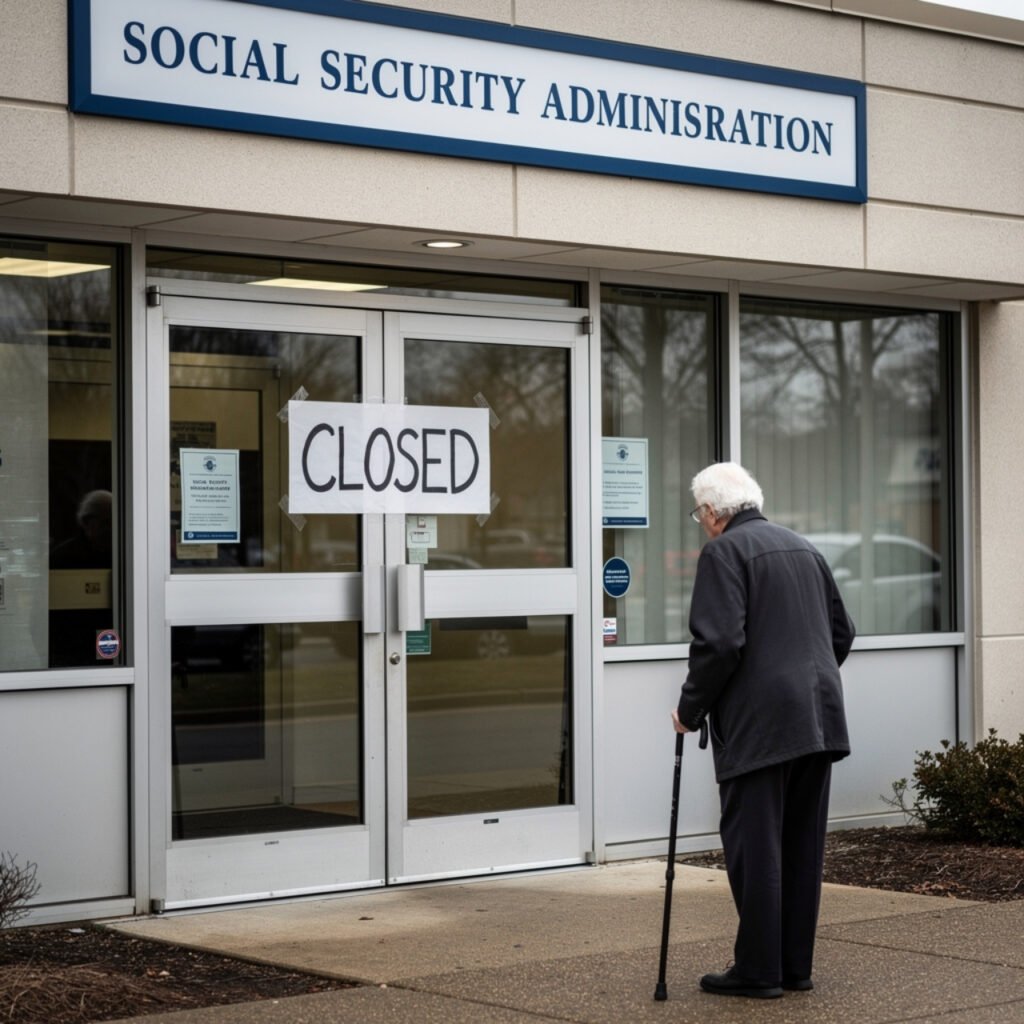
The broader economy offers little cushion. Real GDP growth slowed to 1.4 percent in the fourth quarter of 2025, and the unemployment rate drifted to 4.4 percent as of February 2026. Slower growth and a softening labor market mean slower payroll tax inflows exactly the wrong direction when the trust fund is already under pressure. Center for Strategic and International Studies
The Social Security Fairness Act added $17 billion in retroactive payments and contributed to slowing the economic growth that generates payroll tax revenue. The legislation, intended to correct a long-standing inequity for public sector workers, inadvertently added meaningful near-term pressure to the same trust fund already running short. Center for Strategic and International Studies
DOGE Cuts Add a New Layer of Concern
The long-term financial trajectory of Social Security is serious enough on its own. But a separate, more immediate concern has emerged from the Trump administration’s workforce reduction campaign inside the Social Security Administration itself.
The Trump administration and its Department of Government Efficiency have forced the Social Security Administration through a radical transformation, pushing out 7,000 workers to hit an arbitrary staffing reduction target the largest staffing cut in SSA’s history. Time
The practical consequences are already visible. Due to DOGE’s cuts, one SSA staff member now serves 1,480 beneficiaries — more than three times as many as in 1967. The number of beneficiaries has gone up while the number of workers serving them has gone down. Al Jazeera
The long-term financial trajectory of Social Security is serious enough on its own. But a separate, more immediate concern has emerged from the Trump administration’s workforce reduction campaign inside the Social Security Administration itself.
The Trump administration and its Department of Government Efficiency have forced the Social Security Administration through a radical transformation, pushing out 7,000 workers to hit an arbitrary staffing reduction target the largest staffing cut in SSA’s history. Time
The practical consequences are already visible. Due to DOGE’s cuts, one SSA staff member now serves 1,480 beneficiaries — more than three times as many as in 1967. The number of beneficiaries has gone up while the number of workers serving them has gone down. Al Jazeera
There is no shortage of proposed solutions. The problem is political will, not policy creativity.
Analysts at the Penn Wharton Budget Model project that restoring long-range balance would require some combination of higher revenues, slower benefit growth, and reduced initial benefit generosity for future cohorts. Increasing the combined employee-employer payroll tax rate from 12.4 percent to 17.15 percent of payroll would provide just enough resources to cover benefits over the next 75 years but none of the five reform options currently under examination fully restore solvency on their own. NPR
The Committee for a Responsible Federal Budget has proposed a “Six Figure Limit” capping Social Security benefits so that no couple collecting at normal retirement age can claim retirement benefits exceeding $100,000 per year. The measure would target the highest earners while protecting lower-income retirees who depend most heavily on the program. Carnegie Endowment for International Peace
Other proposals on the table include raising the earnings cap subject to payroll taxation, adjusting the full retirement age upward to reflect longer lifespans, and means-testing benefits for the wealthiest recipients. None of these options are politically painless. All of them have constituencies that will push back hard.
Prediction markets closed out 2025 with traders pricing the odds of Social Security tax relief passing in reconciliation at essentially zero, so legislative relief is not guaranteed. Center for Strategic and International Studies
For Americans watching this unfold with growing anxiety, it helps to remember that Social Security has faced a version of this crisis before.
In 1983, bipartisan reforms signed into law by President Ronald Reagan were designed to strengthen the program for decades. Those changes came after Social Security was just months away from running out of money entirely. They required difficult compromises from both parties including benefit adjustments, payroll tax increases, and a gradual increase in the retirement age that took years to phase in. The system survived because elected officials, under enormous pressure, chose to act. EPC
The window for a similarly gradual, less painful approach is still open in 2026. The 2032 timeline gives lawmakers roughly six years to act. The program is not in immediate crisis, and Congress has a strong incentive to avoid an automatic cut that would affect tens of millions of voters. But each new estimate that moves the deadline closer narrows the window for gradual, less painful fixes. Chatham House
The longer Congress waits, the harder and more abrupt any fix will need to be.
Financial advisors are consistent in their guidance, even if Congress is not: do not plan your retirement exclusively around Social Security in its current form.
Financial advisors consistently warn workers not to rely solely on Social Security benefits for future retirement security. The growing uncertainty surrounding the trust fund highlights why retirement planning has become increasingly important for Americans of all ages. NPR
For those within ten years of claiming benefits, the advice is practical: model your retirement budget at 75 to 80 percent of your current expected benefit amount, reduce high-interest debt before retiring, and avoid locking into fixed expenses that assume full benefit levels. The cuts, if they come, will be automatic and uniform they will not distinguish between those who planned around them and those who did not.
The Social Security crisis of 2032 is not a partisan talking point or a think tank hypothetical. It is a CBO projection, a mathematical reality, and a deadline that is now close enough to touch.The insolvency of Social Security’s main trust fund would yield automatic benefit cuts unless Congress acts. Social Security spending is estimated at over $1.6 trillion in 2026 and is projected to rise above $2.7 trillion a decade from now. That trajectory does not correct itself without intervention. World Economic Forum Seventy million Americans are counting on those monthly checks. Millions more are building retirement plans around them. The combination of a depleting trust fund, a hollowed-out SSA workforce, and a Congress that has repeatedly chosen delay over action is a convergence that demands a different response in the years ahead.
Social Security’s finances are worsening and lawmakers are running out of time to fix it. That assessment came from the Peter G. Peterson Foundation in February 2026. Six months later, it remains the most accurate single sentence describing where things stand. Chatham House The 1983 Congress acted when the program was months from collapse. The 2026 Congress has a longer runway. Whether it uses that runway wisely, or squanders it on the same political paralysis that has defined the debate for decades, will determine how tens of millions of Americans spend their retirement years.
Frontier Affairs covers US domestic policy, economics, and retirement security. This article draws on verified data from the Congressional Budget Office, Penn Wharton Budget Model, Committee for a Responsible Federal Budget, Center on Budget and Policy Priorities, Fortune, 24/7 Wall St., The Motley Fool, and TheStreet.