
playstation plus june 2026 games
Thursday, May 20, 2026 Trusted by millions worldwide Back to News Tech PlayStation Plus Subscribers Are About to Lose Another...
Read More → Tuesday, Aprail 7, 2026
Trusted by millions worldwide
KMT peace mission China 2026 prevent accidental escalation.
The 2026 mission is being described by KMT officials as a ‘stabilization initiative’ an attempt to establish practical communication mechanisms, including emergency maritime hotlines, without prejudging the island’s long-term political status.
KMT peace mission China 2026 A high-level delegation from Taiwan’s Kuomintang (KMT) party arrived in Beijing this week, marking the most significant KMT peace mission to China since cross-strait relations deteriorated sharply in recent years. The visit, which began on April 7, 2026, has opened the first sustained diplomatic channel between Taipei and Beijing in nearly a decade and it is already reshaping conversations about security, trade, and sovereignty across the Asia-Pacific region.
The talks are not officially sanctioned by Taiwan’s ruling Democratic Progressive Party (DPP), which governs the island and remains skeptical of direct engagement with Beijing on political terms. Yet the mission has gained international attention, with analysts, foreign governments, and financial markets all watching closely for signs of either breakthrough or breakdown.
The KMT, Taiwan’s main opposition party and historically more open to dialogue with mainland China, has long advocated for what it calls ‘pragmatic engagement’ a framework built on economic cooperation and communication channels rather than confrontation. As military exercises in the Taiwan Strait intensified through 2024 and 2025, and as the United States became increasingly preoccupied with its own domestic political cycle, KMT leadership argued that Taipei needed a direct line to Beijing to prevent accidental escalation.
The 2026 mission is being described by KMT officials as a ‘stabilization initiative’ an attempt to establish practical communication mechanisms, including emergency maritime hotlines, without prejudging the island’s long-term political status. Critics within Taiwan, however, argue the mission risks legitimizing Beijing’s framing of the dispute.
The delegation is led by senior KMT figures and includes former government officials and business representatives. According to KMT party statements released ahead of the visit, the mission has three stated goals: reducing the risk of accidental military conflict in the strait, exploring economic cooperation in joint trade zones, and reopening dialogue on civilian exchanges such as tourism and student programs that were suspended after 2022.

The international reaction has been predictably divided. In Washington, the U.S. State Department said it was monitoring the situation and reiterated its longstanding position that cross-strait differences should be resolved peacefully and without coercion. Behind the scenes, U.S. officials have expressed concern that opposition-led diplomacy could complicate the island’s defense posture — particularly as Washington continues to accelerate weapons deliveries to Taipei.
Tokyo and Canberra have both issued measured statements, emphasizing the importance of transparency and adherence to existing regional security frameworks. Japanese officials, in particular, are wary of any arrangement that could weaken the multilateral security structures underpinning the Indo-Pacific including the Quad alliance and Japan’s own bilateral defense commitments with the United States.
South Korea has remained largely silent, reflecting its own delicate balancing act between economic ties with China and security dependence on the United States.
Financial markets responded with moderate optimism on April 7. Technology stocks tied to Taiwan’s semiconductor supply chain including TSMC’s U.S.-listed shares rose slightly on news of the talks. Analysts noted that even a modest reduction in strait tensions could lower the geopolitical risk premium that has weighed on chip-sector valuations since 2023. However, most institutional investors are treating the mission as a preliminary signal rather than a structural shift.
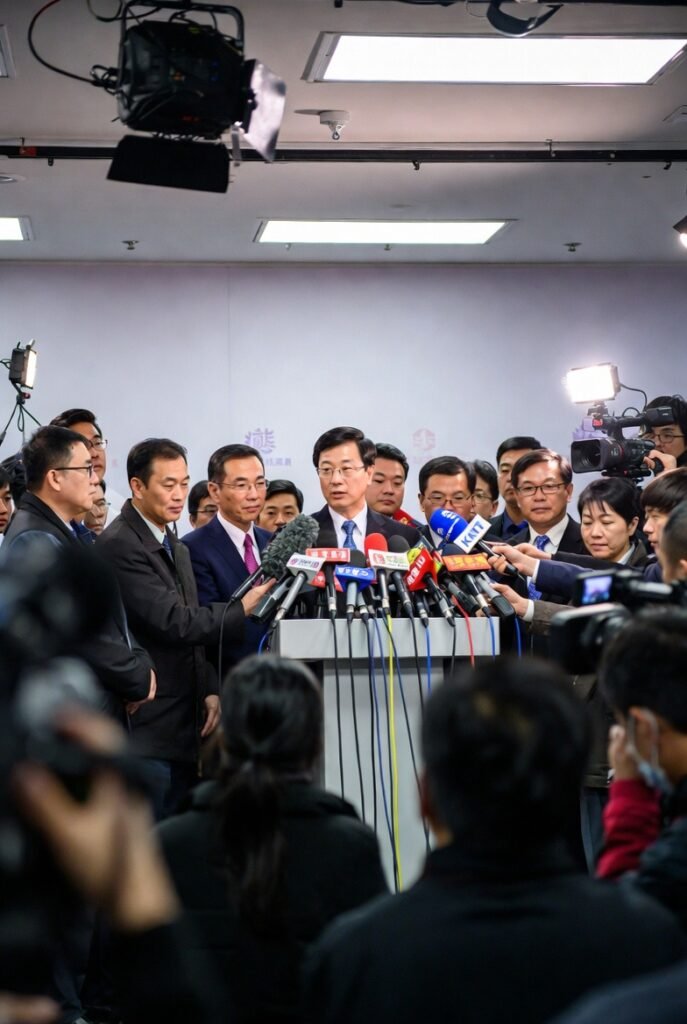
Inside Taiwan, the mission has sparked a sharp political debate. The ruling DPP has distanced itself from the talks, with a government spokesperson stating that any negotiations affecting Taiwan’s sovereignty or security must go through official channels and receive democratic oversight. The party has also cautioned citizens against interpreting the KMT’s visit as a sign of imminent political accommodation.
Public opinion on the island remains divided. Polling conducted in early 2026 shows that a majority of Taiwan’s citizens favor maintaining the status quo rather than rapid movement toward either unification or formal independence. This ambivalence gives the KMT some room to maneuver but also limits how far Beijing can realistically claim the mission represents Taiwanese public sentiment.
China’s government has welcomed the KMT mission, describing it as a ‘positive step’ toward peaceful cross-strait development. Chinese state media has given the visit prominent coverage, framing it as evidence that ‘Chinese people on both sides of the strait’ prefer peace to confrontation a narrative that strategically bypasses the authority of Taiwan’s elected government.
Security analysts caution that Beijing’s engagement is not necessarily a sign of reduced ambitions over Taiwan. Rather, some experts argue, China is pursuing what could be called a dual-track approach: maintaining military pressure and readiness while simultaneously using diplomatic channels to build legitimacy for its preferred political framework. The KMT visit, in this reading, serves Beijing’s long-term narrative goals even if it produces no immediate agreements.

The KMT delegation is expected to hold discussions in Beijing for several days, with the agenda including meetings with officials from China’s Taiwan Affairs Office. No breakthrough announcements are anticipated; both sides have described the sessions as ‘exploratory.’ Whether the talks lead to any formal mechanism such as the proposed maritime hotline remains to be seen.
What is clear, as of April 7, 2026, is that the geopolitical landscape around Taiwan is entering a period of active and unpredictable flux. The KMT peace mission may or may not produce tangible results. But its very existence signals that at least some actors in the Taiwan Strait drama are searching for a way to reduce the temperature — even without a clear roadmap for doing so.
The KMT China Peace Mission 2026 represents a desperate but necessary attempt to rewrite the rules of cross-strait relations 2026. The Beijing Taipei negotiations 2026 are not a guarantee of peace, but a recognition that the cost of silence is too high. As the China Taiwan political tensions dialogue continues, the world is witnessing a high-stakes gamble for the future of Asia Pacific security. On this April 7, 2026, the “Peace Mission” stands as a testament to the fact that in the shadow of a superpower rivalry, the smallest players must be the most strategic.