
playstation plus june 2026 games
Thursday, May 20, 2026 Trusted by millions worldwide Back to News Tech PlayStation Plus Subscribers Are About to Lose Another...
Read More → Wednesday, April 8, 2026
Trusted by millions worldwide
Giorgia Meloni polls decline 2026 Disapproval ratings above 60% (SWG/Ipsos, March 2026). Judicial reform referendum defeated 54–46%. Household energy bills up ~40% since February. Coalition partners Lega and Forza Italia publicly distancing from Meloni ahead of 2027 elections.
Giorgia Meloni’s polls decline in 2026 marks the clearest signal yet that Italy’s center-right government has moved from its long honeymoon phase into genuinely difficult political terrain. For more than three years, the Prime Minister defied the instability that has historically defined Italian politics surviving budget battles, European criticism, and a turbulent geopolitical environment with her coalition intact and her approval numbers resilient. That chapter appears to be closing.
New polling data from SWG and Ipsos Italia, published in late March 2026, shows disapproval of the Meloni government reaching above 60 percent the highest recorded since she took office in October 2022. The shift is not the result of a single misstep. It reflects three converging pressures that have each individually weakened her position and, together, are forcing the Prime Minister into a strategic pivot ahead of the 2027 general election.
The most immediate catalyst for the center-right’s current difficulties was the national referendum held on March 23, 2026. Justice Minister Carlo Nordio’s proposed overhaul of the Italian judiciary specifically a measure to separate the career tracks of judges and public prosecutors was presented by the government as a necessary modernization of an inefficient legal system.
The result was a clear and politically damaging rejection. According to Italy’s Interior Ministry, approximately 54 percent of voters cast a ‘No’ ballot, with notably high turnout that signaled the vote was being treated as a broader referendum on the government’s direction. For a reform that the coalition had invested significant political capital in, the defeat was more than a legislative setback it stripped away the government’s aura of momentum at a critical point in the parliamentary calendar.
The center-left opposition, led by Elly Schlein’s Partito Democratico, has used the result energetically. The broad ‘Campo Largo’ alliance which combines the PD, the Five Star Movement, and smaller progressive parties is polling competitively for the first time in two years. For Meloni, the referendum result halted the government’s legislative agenda and handed her opponents a credible victory narrative to campaign on.
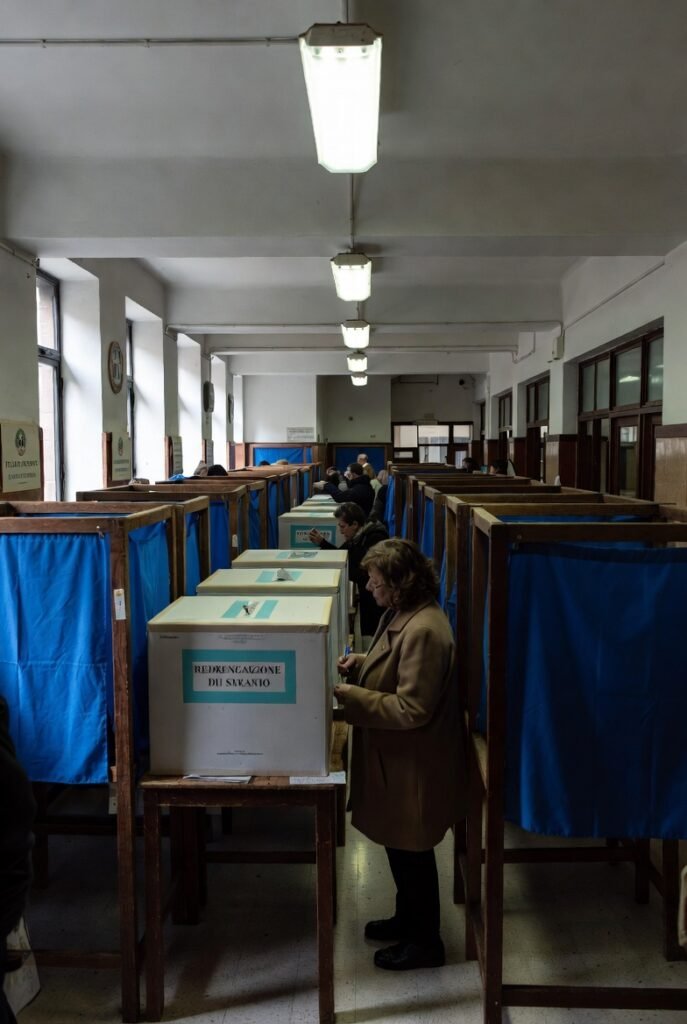
While the referendum dealt a political blow, it is the economic situation that is driving the sharpest deterioration in public sentiment. Italy is structurally one of the most energy-import-dependent economies in the European Union. When global energy markets are stable, this vulnerability is manageable. When they are not as has been the case since the US-Iran crisis escalated in early 2026 Italian households bear disproportionate costs.
The partial blockade of the Strait of Hormuz, which disrupted roughly 21 percent of global oil supply flows earlier this year, sent Mediterranean energy prices to historic highs. Despite the provisional ceasefire announced in early April, the effects on Italian utility bills have not reversed. Household energy costs have risen by an estimated 40 percent since February 2026, according to data from Italy’s national energy authority ARERA a figure that has translated directly into the polling numbers.
The economic pressure is compounded by a structural fiscal problem. The disbursements from the EU’s National Recovery and Resilience Plan funds Italy used to cushion economic shocks and finance reform programs in the first half of Meloni’s tenure are entering their final tranche. Without the flexibility those funds provided, the government has limited capacity to deliver the tax relief packages that were central to the center-right’s 2022 election campaign. This gap between electoral promises and fiscal reality is one of the most corrosive forces in Italian public opinion.
A coalition government is always a negotiated arrangement. During periods of political strength, the different parties within a coalition have strong incentives to maintain unity. As electoral pressures mount, those incentives erode and in Italy’s center-right coalition, the erosion is now visible and accelerating.
Matteo Salvini’s Lega party is experiencing its own acute political crisis independent of Meloni’s difficulties. The Lega’s polling numbers have fallen sharply since the 2022 election, and Salvini aware that he faces potential irrelevance within the coalition has responded by staking out increasingly independent positions on immigration enforcement, EU defense spending, and economic policy.
The result is what analysts in Rome describe as ‘constructive conflict‘ Salvini publicly challenging government positions on issues where he calculates it benefits Lega electorally, while stopping short of formally withdrawing support. For the

government’s public image, however, the effect is damaging: a coalition that projects internal division looks less capable and less decisive to a public already anxious about economic conditions.
Antonio Tajani’s Forza Italia is pursuing a parallel but distinct strategy. Rather than competing on the populist flank, Forza Italia is positioning itself as the coalition’s moderate, pro-European anchor a calculated attempt to capture centrist voters who feel the overall government has drifted too far toward nationalist rhetoric.
This repositioning creates a different kind of internal friction. Every major policy decision from the national budget to Italy’s diplomatic positioning within the European Council becomes a three-way negotiation rather than a unified government decision. For a Prime Minister attempting to project leadership ahead of an election cycle, the optics of constant internal bargaining are a persistent liability.
Giorgia Meloni has been underestimated by political opponents before, and she enters this period of difficulty with genuine institutional resources and strategic experience. Analysts tracking Italian politics expect three significant maneuvers in the months ahead.
Expect Meloni to invest significantly more time and visible effort on the international stage. Italy’s participation in the Islamabad peace process connected to the US-Iran ceasefire, combined with Meloni’s active role within the European Council and her relationship with key EU leaders, provides a platform to project competence and global relevance. The strategic logic is straightforward: positive foreign policy visibility can partially offset negative domestic economic coverage in a media environment that rewards leadership imagery.

Parliamentary sources suggest the government is preparing to advance a new electoral law before the end of the spring session. The proposed reform would adjust the current proportional representation framework in ways that favor larger coalition groupings making it harder for a fragmented opposition to assemble a governing majority. Whether such a reform can pass in the current legislative climate, given the coalition’s internal tensions, remains uncertain.
The most widely anticipated political development in Rome is a significant cabinet reshuffle expected by late May 2026. The reshuffle would serve two functions simultaneously: replacing ministers associated with the referendum defeat and recalibrating the distribution of senior roles among Lega and Forza Italia to reduce public expressions of dissent. A well-executed reshuffle could restore a degree of coalition discipline and give the government a narrative reset ahead of the summer political calendar.
The current polling data does not project a government in immediate danger of collapse. Italy’s parliamentary arithmetic still favors the center-right coalition, and the opposition’s ‘Campo Largo’ alliance has its own internal coherence problems to resolve before it can credibly present itself as an alternative government.
What the numbers do reflect is a government that has lost the political momentum it relied on to drive an ambitious legislative agenda. The Italy 2027 general election forecast is now genuinely competitive in a way it was not twelve months ago. For voters, the cost-of-living crisis is proving a more immediate political reality than ideological battles over judicial independence or immigration policy.
Meloni’s path to a second term runs through the economy. If energy prices stabilize following the US-Iran diplomatic process, if the coalition can hold together through a reshuffle, and if the opposition continues to struggle with its own internal dynamics, the center-right remains in contention. If the economic pressure intensifies and the coalition fractures more publicly, the 2027 election will be far more contested than anyone in Rome anticipated a year ago.
Frontier Affairs will provide live coverage of the Islamabad summit beginning April 10. Follow our World section for continuous updates.