
playstation plus june 2026 games
Thursday, May 20, 2026 Trusted by millions worldwide Back to News Tech PlayStation Plus Subscribers Are About to Lose Another...
Read More → Friday, May 8, 2026
Trusted by millions worldwide
By mavia fazal
For the first time in the history of the world, the United States and Europe are no longer united on what an effective defense of Europe looks like and what costs will be borne by both regions.
By 2026, the US and Europe find themselves in a deepening crisis over their ability to agree on an overall security arrangement. The basic tenets of the post-World War II period (1) collective defense agreement of NATO; (2) America’s forward military presence are now being aggressively challenged. The budgets for defence, the strategic rationale for defence and even the prevailing paradigms regarding the identity of the enemy, are going to officially diverge between Cincinnati and Brussels. Like the Cold War, the repercussions of this breakdown will have far-reaching effects on the future of Western security for the next generation.
However, this is not a single event. It is the cumulative product of years of ongoing, oftentimes silent, pressures that have now been unambiguously brought to the surface by an American Administration that feels conditional alliance is more fiscally responsible than unconditional comradery.
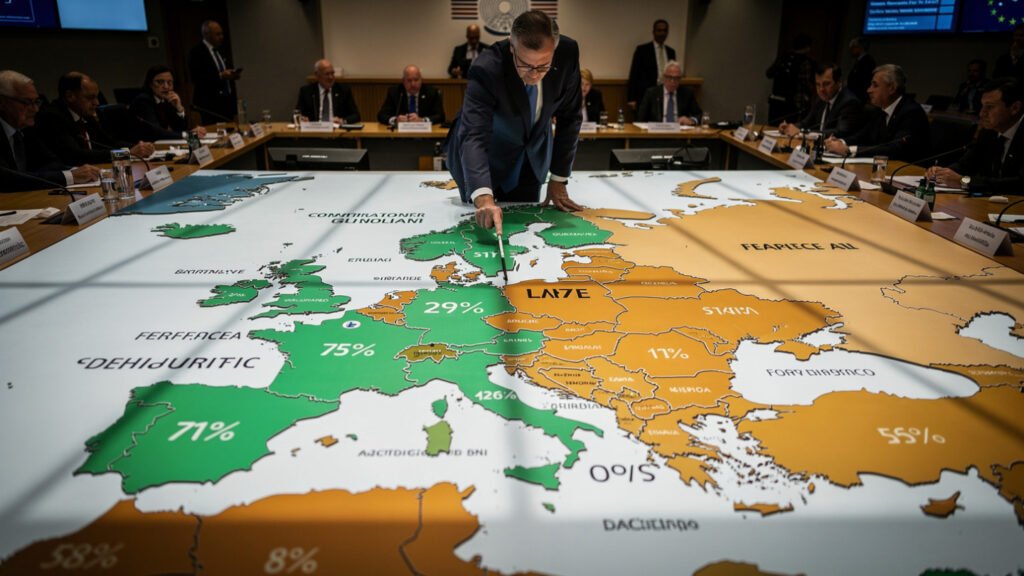
At the center of the transatlantic security rift is a single number: three percent. The Trump administration has demanded that all NATO member states raise defense spending to at least 3% of GDP a significant jump from the existing 2% benchmark that most European countries were still struggling to meet by early 2026.
Poland and the Baltic states countries on the physical frontline with Russia have moved quickly toward or beyond the new threshold. Poland in particular has positioned itself as NATO’s most committed eastern flank member, driven by proximity to Ukrainian battlefields and deep historical memory of Russian aggression.
Germany and France, however, have resisted. French officials have publicly stated that the 3% demand reflects American domestic politics far more than genuine security calculations. German officials, constrained by constitutional debt limits and a coalition government, have warned that rapid budget escalation is simply not feasible in the short term.
The 2026 NDS does not signal a US withdrawal from Europe. But it does end an era. Washington has moved from integrated deterrence managing multiple global threats simultaneously to an explicit hierarchy. China sits at the top. Russia and Europe sit below it.
The policy document is blunt: European allies are described as “rich and capable,” and therefore responsible for managing the Russian threat themselves. US support, the strategy makes clear, will be “selective, incentivized, and contingent on performance rather than promises.”
Perhaps the most alarming development for European capitals is Washington’s decision to link military commitments to economic compliance. The Munich Security Conference’s 2026 report described the transatlantic relationship as one where “access to the US security umbrella” is now “tied more explicitly to alignment with Washington’s economic interests.”
The EU-US trade deal, signed in mid-2025 and widely considered unfavorable to Europe, was later described by multiple European officials as a “concession made to preserve the American security guarantee.” In other words: Europe bought continued protection with economic disadvantage. That bargain is increasingly difficult to justify to European publics.
For years, Europe’s pursuit of “strategic autonomy” was theoretical a policy aspiration that most analysts dismissed as politically impossible. In 2026, it is becoming operational.
The three nations of France, Germany, and Poland have begun to work together on an integrated missile defense programme for their continent; however, they will not consider using any US companies to meet the criteria needed for supplies, but this is also a way of making a strong statement that they want to take control of their defence.
At the same time, Brussels is moving forward with plans to create an EU headquarters for military planning and command to be used by all the countries of Europe (not just the EU member countries) to coordinate joint exercises, logistics and operational planning for all events except those defined as Article 5 under NATO.
European planners are also building a unified cyber-command framework to protect the Eurozone’s financial infrastructure, energy grids, and critical communications networks from state-sponsored attacks. Current European capabilities in this domain remain fragmented. The new framework aims to consolidate them under a single EU-led operational structure explicitly independent of American intelligence sharing arrangements.
The Greenland episode of January 2026 crystallized the crisis. Washington threatened tariffs against Denmark a NATO ally after Copenhagen refused to cede control of the autonomous Arctic territory. The EU responded by threatening to activate its Anti-Coercion Instrument against the United States. NATO attempted a workaround through Operation Arctic Sentry. Trump ultimately backed down, but the episode left a deep impression on European defense planners.
Danish intelligence services had already listed the United States as a potential national security threat in late 2025. That assessment, extraordinary by any historical measure, reflects just how rapidly trust has eroded in the alliance’s core relationships.

European leaders should not mistake the administration’s position for America’s consensus. The 2026 National Defense Authorization Act (NDAA), passed by Congress and signed into law, tells a different story. The NDAA bolsters support for NATO and European allies, maintains prohibitions on Russian energy purchases, and identifies Russian military strategy as a direct threat to US security.
As the German Marshall Fund of the United States observed, “Congress remains a stalwart pro-NATO body.” The NDAA signals a “measured distance” between legislators and the White House on European security. That gap creates both opportunity and uncertainty for European governments navigating Washington’s mixed signals.
The optimistic scenario: European states meet or exceed the 3% GDP benchmark. The US-Europe security alignment stabilizes on new terms Europe handles conventional deterrence against Russia while the US retains nuclear oversight and high-end capabilities. NATO survives as a functional alliance, restructured but intact.
A second scenario sees a functioning but fragmented Atlantic: NATO continues as the formal umbrella while the EU builds an independent military command, procurement system, and intelligence framework. The two structures are complementary in theory but often competitive in practice a recipe for duplication and delayed response.
The most dangerous scenario: a further deterioration of political trust, accelerated by the 2026 US midterm elections, produces an effective American withdrawal from European defense commitments. Russia, watching closely, recalibrates its risk calculus accordingly. This is the scenario that EUISS experts call “strategically seismic” as severe in impact as Russian nuclear use, and significantly more likely.

The US-Europe security alignment in 2026 is not merely a regional problem. NATO’s deterrence has always rested on the credibility of Article 5 the promise that an attack on one ally is an attack on all. If adversaries perceive that promise as conditional, the security calculus changes across the entire Euro-Atlantic space.
Financial markets have already begun pricing in this uncertainty. Defense equities on both sides of the Atlantic have seen elevated volatility. The EUR/USD currency pair reflects investor anxiety about a less integrated West. And in Moscow, analysts are surely watching whether the alliance’s fractures can be exploited.
A weaker transatlantic bond is not an abstract geopolitical problem. It is a concrete risk to the rules-based international order that has, for all its flaws, kept great-power war from European soil for eight decades. Whether Washington and its European partners can forge a new bargain one that distributes defense burdens fairly without abandoning mutual commitment is the central question of 2026’s security landscape. The answer will define what the Western alliance means in the decades ahead