Australia voter dissatisfaction 2026
Monday, Aprail 13, 2026 Trusted by millions worldwide Back to News Polotics Australia Political Crisis 2026: Voter Dissatisfaction Intensifies Frontier...
Read More → 
Monday, Aprail 13, 2026
Trusted by millions worldwide
EU defense coordination 2026 The framework currently under negotiation and subject to final ratification by the European Council rests on three structural pillars that would represent the most significant shift in EU security architecture since the establishment of the Common Security and Defence Policy (CSDP).
EU defense coordination 2026 European Union leaders have accelerated plans for a new EU defense coordination framework in April 2026, outlining a comprehensive roadmap to reduce the bloc’s dependence on external security guarantees. At the centre of these discussions is a proposed joint military oversight structure informally dubbed the Brussels Defence Framework which would give EU institutions a direct coordinating role over national defence procurement, capability development, and crisis response.
The push comes against a backdrop of shifting transatlantic relations, ongoing conflict at Europe’s eastern borders, and rising pressure from EU member states to demonstrate strategic credibility independent of external alliances. Defence ministers from 18 member states endorsed a joint communiqué in early April 2026 calling for a ‘structured, permanent’ EU military coordination body a proposal that now forms the basis of ongoing negotiations in Brussels.
The framework currently under negotiation and subject to final ratification by the European Council rests on three structural pillars that would represent the most significant shift in EU security architecture since the establishment of the Common Security and Defence Policy (CSDP).
The first pillar calls for a permanent Brussels-based coordination office tasked with overseeing joint procurement processes for defence equipment, ammunition, and dual-use technology. Rather than replacing NATO structures, proponents argue the office would eliminate costly duplication between the 27 member states’ defence budgets an inefficiency the European Defence Agency estimates costs the EU upwards of €25 billion annually.
The second pillar introduces binding targets for sourcing defence technology from within the EU’s single market. This would directly support the bloc’s existing European Defence Industrial Strategy (EDIS), launched in March 2024, which set an ambitious goal of procuring at least 50% of defence equipment from European suppliers by 2030. The April 2026 proposals would accelerate this timeline and introduce procurement penalties for non-compliance.
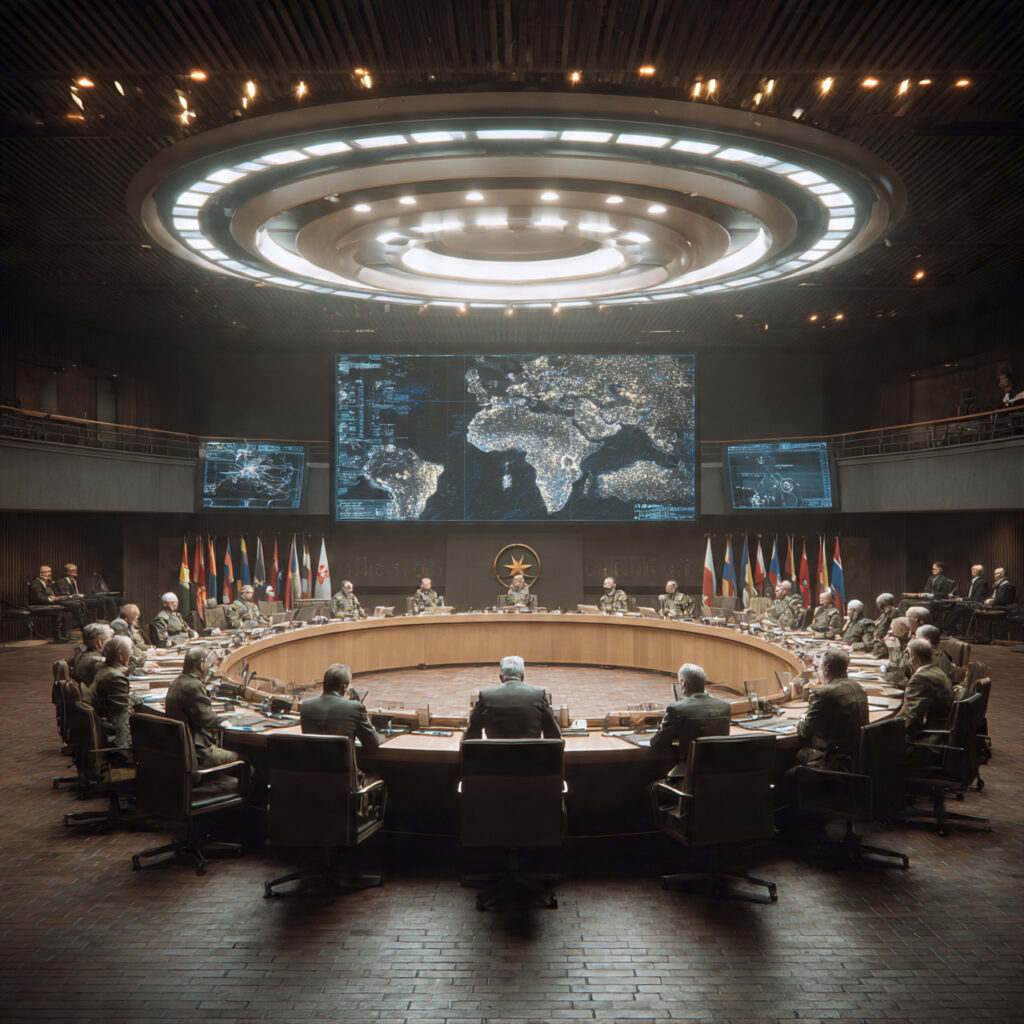
The EU’s accelerated defence cooperation push has prompted careful diplomatic messaging from NATO Secretary-General Mark Rutte, who has publicly welcomed European defence investment while cautioning against any structural duplication that could weaken Alliance coherence.
EU officials have been equally measured. French President Emmanuel Macron a long-standing advocate of European strategic autonomy framed the April 2026 proposals not as a challenge to NATO but as a strengthening of what he called the ‘European pillar of the Alliance.’ Germany and Poland, the two largest military spenders among EU member states, have both signalled conditional support contingent on maintaining full interoperability with NATO command structures.
Analysts note that the practical distinction between ‘EU defence coordination’ and ‘competing with NATO’ may depend heavily on implementation details that remain unresolved. Key among these is whether the proposed Brussels coordination office would have any authority over forces earmarked for NATO missions a question that defence ministries in Warsaw, Berlin, and Rome have flagged as a red line.
Perhaps the most consequential question surrounding the Brussels Defence Framework is whether EU member states have the fiscal capacity to fund it. In 2024, only 23 of the 32 NATO member countries met the Alliance’s 2% of GDP defence spending target. Among EU-only members, the compliance rate was lower.
The April 2026 framework proposes a new EU Defence Investment Fund, seeded with €100 billion over ten years, drawing on a combination of member state contributions and joint EU borrowing a mechanism that proved politically divisive during the COVID-19 recovery fund debates. Several fiscally conservative member states, including the Netherlands and Austria, have raised concerns about open-ended defence liability pooling.
Supporters counter that the economic case is strong: a 2025 study by the Kiel Institute for the World Economy found that coordinated EU defence procurement could reduce per-unit costs by 15–25%, generating savings that partially offset the new investment requirement.

The framework places particular emphasis on two geographic corridors identified as highest priority in the EU’s 2025 Strategic Compass review: the Eastern Partnership Zone (covering the Baltic states, Poland, Romania, and Moldova) and the Southern Mediterranean corridor (encompassing migration pressures, energy supply security from North Africa, and maritime security in the Central Mediterranean).
For Eastern flank states, the framework offers accelerated access to joint intelligence-sharing platforms and pre-positioned logistics capacity. For Southern members such as Italy, Greece, and Spain, the proposed digital resilience network and joint maritime surveillance capability address longstanding capability gaps that national budgets have struggled to fill unilaterally.
The Brussels Defence Framework is not yet law. The European Council is expected to hold a formal debate on the proposals at its June 2026 summit, with a full legislative package including the legal basis for the coordination office and the Defence Investment Fund anticipated by Q4 2026, subject to ratification by member state parliaments.
The timeline is ambitious, and precedent suggests that EU defence initiatives frequently encounter political delays. However, the April 2026 communiqué marks a genuine shift in political will. With defence spending across the bloc at its highest sustained level since the Cold War, and with the geopolitical environment providing a persistent sense of urgency, the structural conditions for deeper EU military cooperation may be more favourable now than at any previous point in the bloc’s history.

The Brussels Defense Coordination Plan represents a fundamental reset of the European project. The EU leaders defense cooperation proves that in an era of geopolitical strategy and shifting alliances, unity is no longer a luxury it is a survival mechanism. As the Europe joint military planning continues to mature, the world is witnessing the rise of a more assertive and independent European power. On this April 13, 2026, the “Brussels Plan” stands as a testament to the belief that to protect its values, Europe must finally be prepared to protect its borders.