
playstation plus june 2026 games
Thursday, May 20, 2026 Trusted by millions worldwide Back to News Tech PlayStation Plus Subscribers Are About to Lose Another...
Read More → Tuesday Aprail 7, 2026
Trusted by millions worldwide
US-China trade war 2026 In March , the US Trade Representative (USTR) launched fresh Section 301 investigations into Chinese industries, citing “structural excess capacity” across manufacturing sectors.
US-China trade war 2026 One year after President Trump’s sweeping “Liberation Day” tariffs shook global markets, the US-China trade war 2026 has entered a new and uncertain phase. With a major diplomatic summit now scheduled for May 2026 Trump’s first visit to Beijing in eight years and the US Supreme Court having struck down key tariff tools in February, both Washington and Beijing are navigating a relationship that is simultaneously adversarial and indispensable.
When Trump announced his Liberation Day tariffs on April 2, 2025, US tariffs on Chinese goods rapidly escalated to 145 percent, triggering 125 percent counter-tariffs from Beijing. Within weeks, trade between the world’s two largest economies had fallen to levels not seen since the 2008–2009 financial crisis, according to data from the Peterson Institute for International Economics (PIIE).
The two sides pulled back from the brink in May 2025, agreeing in Geneva to reduce tariffs to 10 percent for 90 days. That truce was extended in August, and again in October after Trump and Chinese President Xi Jinping met in Busan, South Korea. Under the Busan agreement, the reduced 10 percent tariff rate was extended until November 10, 2026.
Then came a major legal turning point. On February 20, 2026, the US Supreme Court ruled that Trump could not use the International Emergency Economic Powers Act (IEEPA) to impose tariffs, invalidating the legal foundation for hundreds of billions of dollars in duties. The ruling forced the administration to pivot to slower-moving tools: Section 301, Section 232, and Section 122 investigations.
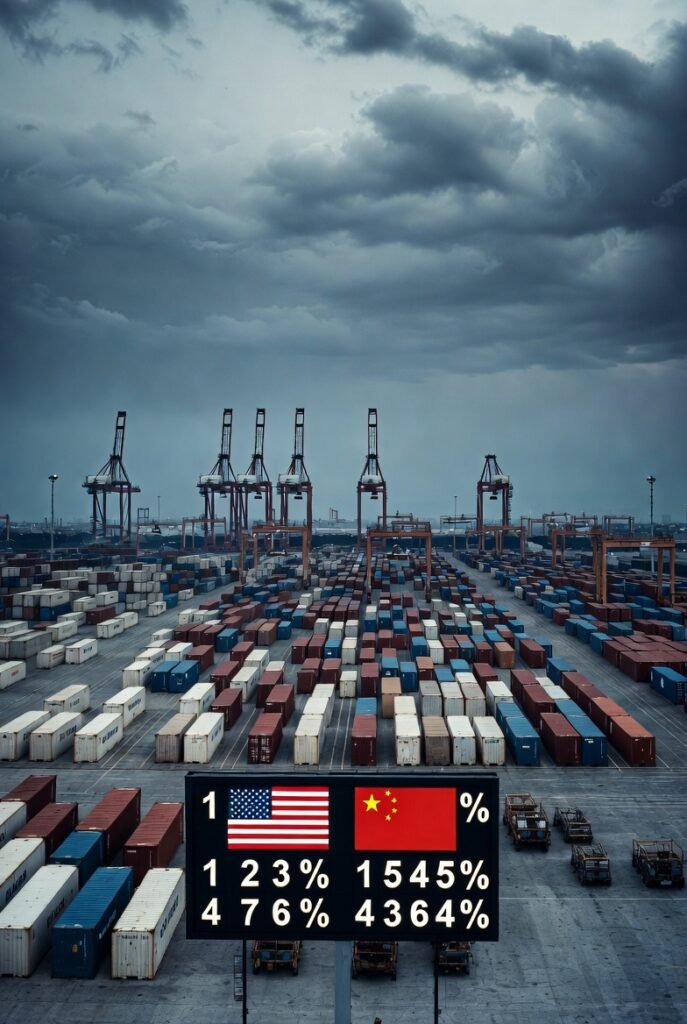
As of April 6, 2026, the average US tariff on Chinese imports stands at approximately 47.5 percent, covering 100 percent of all goods. China’s average tariff on US exports sits at around 31.9 percent. While these figures are dramatically lower than the April 2025 peak of 164 percent (US) and 125 percent (China), they remain historically high more than 15 times higher than pre-2018 levels, according to PIIE analysis.
In March 2026, the US Trade Representative (USTR) launched fresh Section 301 investigations into Chinese industries, citing “structural excess capacity” across manufacturing sectors. Hearings are scheduled for April and May. If the investigations conclude that further action is warranted, a new round of tariffs could follow potentially disrupting the diplomatic momentum building around the May Beijing summit.
The tech and semiconductor industries remain central to the dispute. Beijing’s export controls on rare earth elements China accounts for over 90 percent of global rare earth magnet production nearly halted US automotive supply chains in 2025 on two separate occasions. These restrictions were partially lifted as part of the October 2025 Busan deal, but the vulnerability remains.
US agricultural exports have also taken a significant hit. US soybean sales to China fell to their lowest level since 2018, as Beijing has actively diversified its supply chains toward Brazil and Argentina. While China committed to resuming some US agricultural purchases under the Busan agreement, industry groups have warned that future purchase commitments for 2026–2028 are “below the status quo.”
Trump’s planned visit to Beijing in May 2026 has been described as a “high-stakes diplomatic mission” arriving at one of the most complex moments in modern US-China relations. The two sides have held six rounds of trade talks, most recently in Paris in March 2026.

A successful summit outcome might include further tariff reductions beyond the current truce, firmer Chinese commitments on agricultural purchases, new agreements on rare earth supply chains, and guardrails on emerging technology competition. However, the structural issues particularly around semiconductor supply chains and China’s industrial policy are unlikely to be fully resolved in a single meeting.
Global financial markets have been closely watching the US-China trade situation throughout 2026. The US Supreme Court’s February ruling injected a new layer of uncertainty, as businesses sought clarity on which tariffs would remain in force and which would be refunded. The US Customs service is currently working on processing refunds for the roughly $166 billion in IEEPA tariffs the court found unconstitutional.
Supply chains remain the most visible casualty of the past year. Companies have accelerated the diversification of manufacturing away from China into countries like Vietnam, India, and Mexico a trend that is unlikely to reverse quickly regardless of summit outcomes. For multinational corporations, the era of treating China as a single-source manufacturing hub appears to be ending.

What the past year has demonstrated is that the US-China trade relationship has moved beyond a simple tariff dispute. It now encompasses technology competition, supply chain security, rare earth dependencies, and competing visions for the future of global trade governance. The WTO, which lacks effective tools to arbitrate disputes between major powers operating outside normal rule-based frameworks, has largely been sidelined.
The scheduled Trump-Xi summit in May 2026 offers a genuine opportunity to stabilize the relationship and potentially outline a longer-term framework. But as the six rounds of talks in Paris and elsewhere have demonstrated, the deep structural tensions between Washington and Beijing will not be resolved by any single meeting. For businesses, investors, and policymakers alike, navigating the US-China trade war 2026 will continue to require careful attention to a rapidly shifting landscape.
The Trump Beijing Visit Delay 2026 represents more than a missed meeting; it is the formalization of a “Strategic Divorce.” The US-China trade negotiations delay proves that neither side is willing to blink in the face of economic pressure. As the bilateral trade conflict 2026 continues to escalate, the dream of a unified global market is being replaced by a fragmented reality of “fortress economies.” On this April 6, 2026, the world is learning that in a war of titans, there are no bystandersonly casualties of international trade policy.
Frontier Affairs will continue to update this story as developments emerge. Follow our live coverage feed for the latest.