
playstation plus june 2026 games
Thursday, May 20, 2026 Trusted by millions worldwide Back to News Tech PlayStation Plus Subscribers Are About to Lose Another...
Read More → Sunday,Aprail 5, 2026
Trusted by millions worldwide
This failure has become a defining symbol of the governance gap between Canberra’s promises and lived reality.
Australia political crisis 2026 Australia’s political landscape is undergoing its most significant transformation in decades. The country’s ongoing political crisis in 2026 is no longer limited to policy disputes between the Labor government and the Coalition it has grown into a broad public rejection of the political establishment itself. From skyrocketing housing costs to stalled infrastructure and high-profile governance scandals, Australians across the political spectrum are demanding accountability in a way not seen since the post-war era.
Australia faces what analysts are calling a ‘twin crisis’: a domestic cost-of-living emergency running in parallel with increasing instability in the Indo-Pacific region.
Neither Labor nor the Coalition has presented a credible, unified response to either challenge. Internal power struggles within both major parties have resulted in what Grattan Institute researchers have described as ‘decision paralysis’ months passing without substantive legislation reaching the Senate floor.
The political fallout has been swift. Independent and minor party candidates have surged in national polls throughout early 2026, continuing the ‘Teal’ movement’s momentum from the 2022 election. Polling from the Australian Electoral Commission (AEC) and Resolve Strategic suggests that a minority parliament is now the most likely outcome in the next federal election.
No single issue has unified Australian anger more than housing affordability. In Sydney and Melbourne, average rental prices have increased by more than 30 percent over three years, according to CoreLogic data from March 2026. First-time homeownership rates among Australians aged 25–35 have fallen to their lowest recorded level.

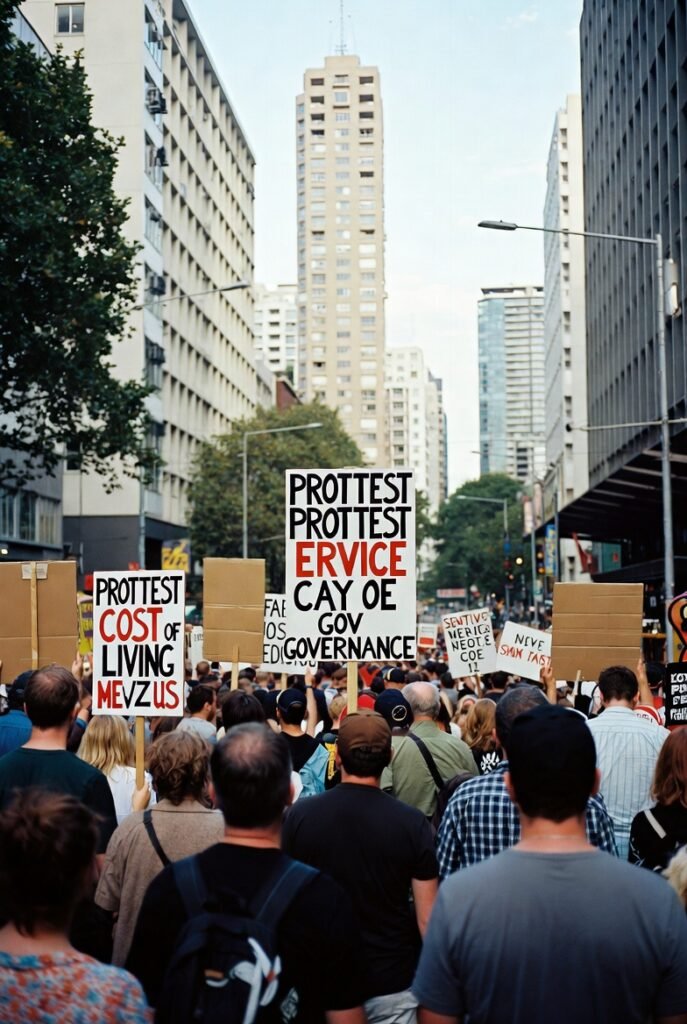
In late March 2026, tens of thousands of Australians joined non-partisan ‘Cost-of-Living Protests’ in Melbourne and Brisbane. What made these demonstrations notable was their composition participants ranged from young renters to retirees on fixed incomes, cutting across the usual demographic and ideological divides.
Protest organisers called for a ‘Total Governance Audit,’ demanding greater transparency over how public funds are allocated to housing, energy, and infrastructure. The emergence of organised, non-partisan civic pressure is a new dynamic in Australian political life.
The federal government’s handling of AUKUS-related defence contracts has drawn intense scrutiny in 2026. A parliamentary inquiry into defence procurement found irregularities in how multi-billion dollar submarine infrastructure contracts were awarded, with multiple suppliers having prior associations with former government ministers.
The inquiry has not produced criminal charges, but the political damage has been considerable further deepening what polling firm RedBridge describes as a ‘structural decline in institutional trust’ among Australian voters.
In February 2026, a significant data breach compromised the personal records of an estimated 2.4 million Australians held by a federal government contractor. The incident reignited public frustration over the government’s digital security framework especially given that Australia had already experienced major private sector breaches in 2022 and 2023.
For many voters, the breach was the final confirmation that the administrative state is not keeping pace with digital-era risks.
The political crisis has also exposed deepening fault lines within Australia’s federal structure.
Western Australia and Queensland have publicly challenged federal resource taxation proposals, with both state governments arguing that revenue sharing arrangements unfairly disadvantage resource-producing regions. While such tensions are not new, the tone has hardened considerably in 2026, with state premiers making unusually direct criticisms of federal authority.
Constitutional lawyers and federalism scholars have noted that Australia’s federation is experiencing stress at multiple levels simultaneously fiscal, legislative, and political in a way that has no direct precedent in the post-war era.
The Australian political crisis of 2026 is not simply a bad patch for an unpopular government. It reflects a deeper structural shift in how Australians relate to political institutions.
The surge in support for independents and minor parties suggests that the era of two-party dominance which has defined Australian federal politics since 1949 may be giving way to a more fragmented, pluralistic model. This mirrors trends observed in Canada, the United Kingdom, and parts of Europe over the past decade.
Whether that fragmentation produces better governance depends entirely on whether new political actors can convert protest energy into coherent policy programs. So far, the most successful independent candidates have distinguished themselves through local accountability and transparency values that the major parties have struggled to embody.
For now, Australian democracy is at a crossroads. The 2026 federal election will be a critical test of whether the political system can adapt — or whether the public’s frustration will deepen further into genuine disillusionment with democratic institutions themselves.

The Australia Governance Crisis 2026 represents a structural realignment of the Australian psyche. The Australia voter anger 2026 is not a temporary tantrum; it is the birth of a new, more demanding political era. The Australia government failure debate has made it clear that “business as usual” in Canberra is dead. On this April 5, 2026, the question is whether the Australian political system can evolve fast enough to save itself, or if the current political instability Australia is merely the preamble to a much larger institutional collapse.