
playstation plus june 2026 games
Thursday, May 20, 2026 Trusted by millions worldwide Back to News Tech PlayStation Plus Subscribers Are About to Lose Another...
Read More → Thursday, Aprail 2, 2026
Trusted by millions worldwide
France EU strategy 2026 | Cooper Flagg NBA Draft 2026 | NCAA March Madness Selection Sunday 2026 | Clemson Carter Welling injury ACL | ACC Tournament semifinal Charlotte 2026 | Duke Blue Devils No 1 seed March Madness
The recent informal European summit held near Versailles brought France’s growing leadership role into sharp focus. With Germany navigating internal coalition tensions and the United Kingdom managing post-Brexit economic pressures, President Emmanuel Macron has emerged as the primary architect of European policy.
France is now advocating for a restructured EU decision-making model — one that would allow a core group of deeply integrated member states to act quickly on defense and diplomatic matters, without being delayed by the EU’s traditional requirement for unanimous agreement among all 27 members.
This proposal is controversial. Critics argue it risks creating a two-tier Europe where smaller nations lose influence. Supporters say it is the only realistic path to effective EU governance in an increasingly competitive world.
France’s assertive European agenda has not come without friction. Senior US officials have raised concerns that a more autonomous Europe could weaken the cohesion of the transatlantic alliance, particularly within NATO structures.
Eastern European members especially Poland and the Baltic states have expressed reservations of a different kind. They worry that an emphasis on “European sovereignty” could reduce the political weight given to US-backed collective defense guarantees, which many consider essential given the ongoing security situation at NATO‘s eastern flank.
France’s response has been to frame its strategy as complementary to, not a replacement for, NATO commitments arguing that a stronger Europe actually makes the alliance more effective overall.
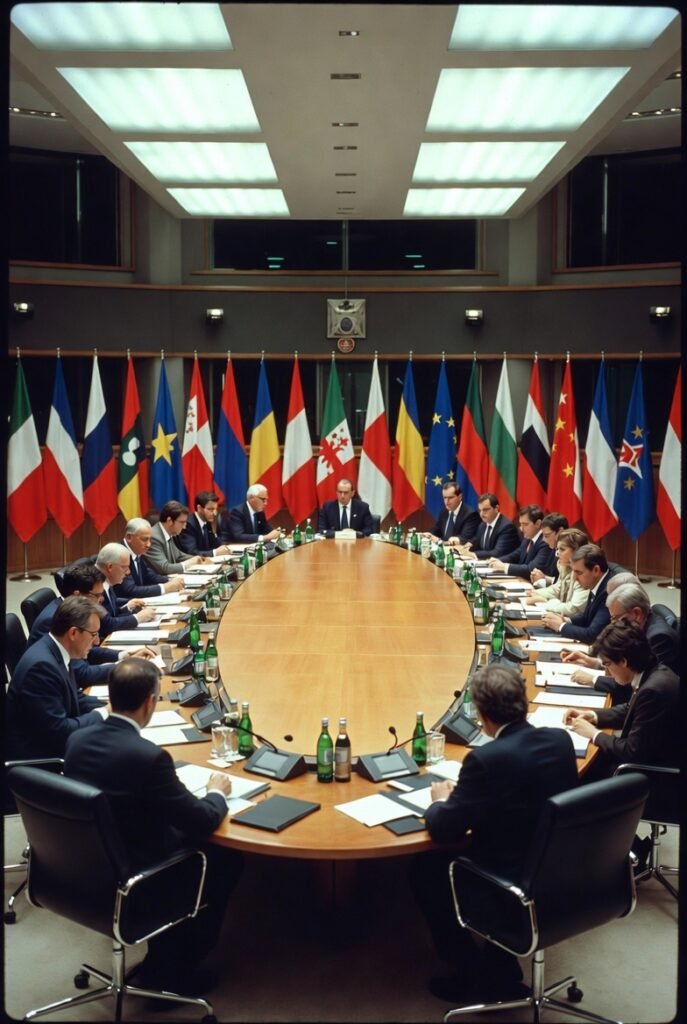
France’s foreign policy agenda in 2026 builds directly on the EU’s Strategic Compass a defense and security framework that has been in development since 2022. Under French leadership, three priorities have come to the forefront:
1. European Defense Independence
France is pushing for significantly increased joint military research and development across the EU, with a clear preference for European-manufactured defense equipment over imports from the United States. The EU’s goal of establishing a Rapid Deployment Capacity a joint force of 50,000 troops is central to this effort, with France leading command and logistics planning.
2. Economic Resilience Against External Pressure
The proposed “European Preference” policy would require EU governments to prioritize European companies in major public procurement contracts, particularly for critical infrastructure projects. Alongside this, a new Anti-Coercion Instrument is being advanced to shield European businesses from the collateral damage of US-China trade disputes.
3. Energy Sovereignty Through Nuclear Cooperation
France Europe’s largest producer of nuclear energy is leading an effort to expand nuclear power cooperation across the EU. The goal is to reduce Europe’s dependence on imported fossil fuels and insulate the bloc from volatile global energy markets, a lesson drawn sharply from the 2022 energy crisis.
One of the newer dimensions of the France-led EU strategy is a focus on digital sovereignty. Proposals currently being fast-tracked include the establishment of a “Sovereign AI Cloud” a Europe-based data infrastructure designed to protect EU citizens‘ data from extraterritorial legal claims by non-EU governments.
A unified AI governance framework is also under development, aimed at ensuring that artificial intelligence systems operating in Europe comply with EU standards on transparency, fairness, and data protection. This positions Europe as a potential global standard-setter in AI regulation, distinct from both American and Chinese approaches.
Duke is projected as the No. 1 overall seed in the NCAA Tournament regardless of tonight’s result. The Blue Devils’ 30-2 record and strength of schedule ensure that a semifinal or even final loss does not cost them their expected seed. However, winning the ACC championship Duke’s potential 24th would deliver a strong psychological statement heading into the bracket reveal.
Specifically, Selection Sunday takes place tomorrow, March 15, at 6:00pm ET on CBS. The full 68-team field will be revealed, with the bracket encompassing four regions seeded 1 through 16. The First Four play-in games begin in Dayton, Ohio, on March 17 and 18. First-round games in the 64-team bracket begin March 19. The Final Four is set for Lucas Oil Stadium in Indianapolis, Indiana, on April 4 and 6.
The central question for European politics in 2026 is whether France’s vision of a more sovereign, more assertive EU will unite the bloc or divide it.
There are real risks. Smaller member states may feel sidelined by a “core group” decision-making model. US allies within Europe may resist policies perceived as anti-American. And ambitious defense targets require sustained political will and significant public funding.
But there are also real opportunities. A more self-sufficient Europe could reduce its vulnerability to external shocks, from energy crises to geopolitical disruptions. And a coherent EU foreign policy backed by credible military and economic tools could give Europe far greater influence in international negotiations.
France’s EU strategy in 2026 represents one of the most ambitious attempts to redefine European integration since the Maastricht Treaty. Whether it succeeds will depend heavily on whether Macron can bring Germany, Poland, and smaller EU members along not just lead from the front.
What is clear is that Europe is no longer content to be a passive actor in global affairs. The decisions made in Brussels and Paris over the next 12 to 18 months will shape the EU’s role in the world for decades to come.