
playstation plus june 2026 games
Thursday, May 20, 2026 Trusted by millions worldwide Back to News Tech PlayStation Plus Subscribers Are About to Lose Another...
Read More → Monday, March 30, 2026
Trusted by millions worldwide
Politics
US Iran military escalation 2026 Iran’s retaliation strategy shocked even pessimistic Western analysts. Tehran attacked all six Gulf Cooperation Council states simultaneously Bahrain, Kuwait, Oman, Qatar,
The US Iran military escalation 2026 entered its most dangerous chapter on Day 30. On Sunday, Trump told the Financial Times that his ‘preference would be to take the oil in Iran’ explicitly naming Kharg Island, the tiny coral outcrop that handles 90% of Iran’s crude exports, as a potential seizure target. On Monday morning, he escalated further, warning he would ‘completely obliterate’ Iran’s electric plants, oil wells, and Kharg Island if the Strait of Hormuz was not immediately reopened. As those words circulated, Spain announced it had closed its airspace to US aircraft involved in Iran operations and Iran revealed it had been quietly laying booby traps on Kharg for weeks.
Thirty days after Operation Epic Fury began on February 28, 2026 killing Supreme Leader Ali Khamenei, triggering the largest Middle East war since 1973, and unleashing Iran’s most expansive retaliatory campaign in history across every Gulf Cooperation Council member state simultaneously the trajectory of the conflict points in one direction: deeper.
The US Iran tensions 2026 did not erupt without precedent. The escalation ladder stretched back through the Twelve-Day War of June 2025, through Iran’s violent suppression of January 2026 protests which killed between 3,117 and more than 6,126 people by human rights counts and through a months-long strategic deception campaign by US and Israeli intelligence that masked strike preparations from Iranian surveillance satellites.
At precisely the moment Iranian senior leadership believed the threat had subsided, US and Israeli forces struck simultaneously on February 28, 2026. Supreme Leader Ali Khamenei died in an Israeli airstrike on his compound in the opening hours, alongside his daughter, son-in-law, grandchild, and daughter-in-law. Dozens of senior IRGC commanders died in the first wave. Within 48 hours, CENTCOM confirmed more than 1,000 targets struck across at least 26 of Iran’s 31 provinces, with Tehran enduring the heaviest urban bombardment in the theatre.
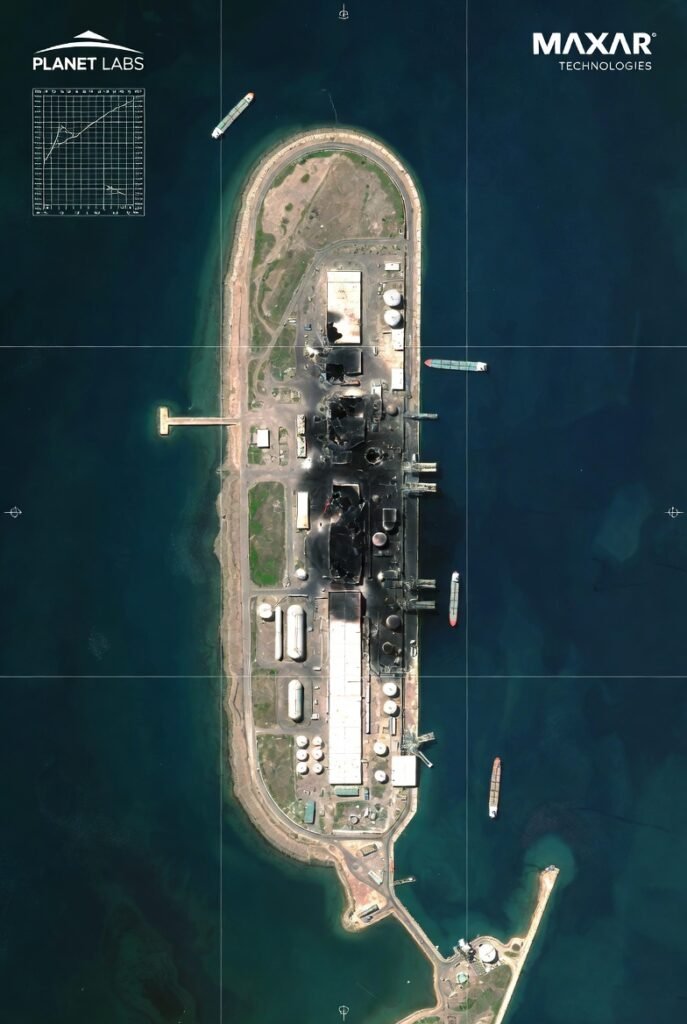
Kharg Island is not merely a future option. US warplanes struck it on March 13, hitting 90 confirmed targets naval mine storage facilities, missile storage bunkers, and multiple military sites according to CENTCOM. Trump announced the strike on Truth Social, saying US forces had ‘obliterated’ military targets while deliberately avoiding oil infrastructure ‘for reasons of decency.’
Now, ground seizure is openly under consideration. The island, a five-mile coral outcrop approximately 16 miles off Iran’s southwestern coast deep in the northern Persian Gulf, handles 90% of Iran’s crude exports. Seizing it would, in theory, give the US direct leverage over Iran’s oil income and therefore over its ability to fund the war. Trump told the Financial Times on Sunday: ‘My favourite thing is to take the oil in Iran.’ He compared it to the US’s recent seizure of Venezuela’s oil industry following Nicolás Maduro’s capture in January 2026.
Iran is not waiting passively for a US landing. CNN reported on March 25, citing multiple US intelligence sources, that Iran has been laying booby traps across Kharg Island, moving additional IRGC infantry and defensive personnel onto the island, and deploying MANPAD shoulder-fired surface-to-air missile systems to intercept US helicopters and aircraft in any amphibious assault. The island already features layered permanent defences.
Gulf allies are privately warning Washington against the move. A senior Gulf official told CNN that occupying Kharg with US troops ‘would result in high casualties’ and would likely trigger massive Iranian retaliation against Gulf countries’ own infrastructure potentially dragging Gulf states into a conflict they are desperate to exit. Retired Admiral James Stavridis, the former NATO Supreme Allied Commander and CNN military analyst, was blunt: ‘I would be very worried about this.’
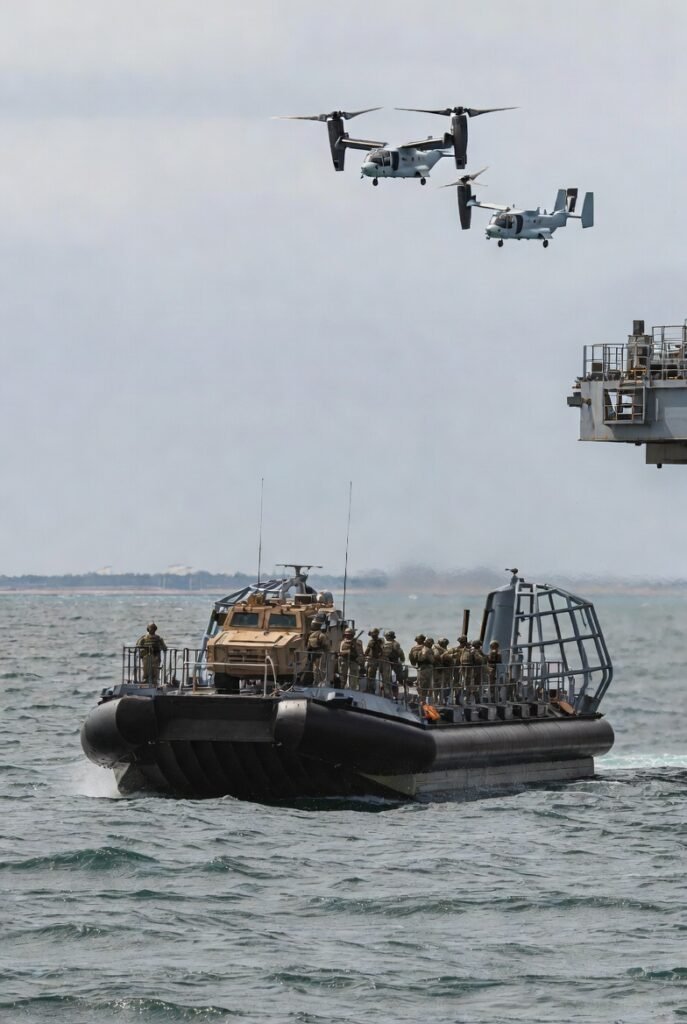
The Pentagon has developed at least three distinct ground operation options, according to Axios (March 26), the Washington Post (March 29), and CNBC (March 26). The most operationally realistic option, according to military analysts cited by CNBC, involves limited action along the Strait of Hormuz securing key maritime terrain and suppressing Iranian threats to shipping. The second option is Kharg Island seizure: technically feasible, but described by CNBC analyst James Stewart as ‘escalatory, given its centrality to Iran’s oil exports,’ and requiring a robust landing force because the island is roughly one-third the size of Manhattan.
The third and most politically explosiveoption was revealed by Secretary of State Marco Rubio at a congressional briefing. Rubio said the US may need to physically secure Iran’s nuclear material. ‘People are going to have to go and get it,’ he told Congress. Satellite imagery confirms the Isfahan Tunnel Complex where analysts estimate more than 200 kilograms of 60%-enriched uranium is stored in deep underground tunnels survived the initial airstrikes. IAEA Director General Rafael Grossi has confirmed he cannot monitor the situation in the current security environment.
Understanding Iran’s response requires recognising that Tehran is not simply reacting it is executing a calculated strategy designed to impose costs while managing its own depleting resources and preventing regime collapse.
Pillar One: Exhaust US Missile Defence
By firing 500 ballistic missiles and 2,000 drones, Iran forced the United States to expend Patriot and THAAD interceptors at a pace that creates real resupply pressure on US defence industrial capacity. The cost asymmetry is stark: Iranian Shahed-class drones cost approximately $20,000–$50,000 per unit; the interceptors used to destroy them cost $1–3 million each. Iran’s missile launch rate subsequently declined, with ACLED analysts noting both stockpile depletion and a deliberate rationing strategy to sustain pressure across a longer conflict horizon.
The geopolitical tensions surrounding the US Iran military escalation 2026 span every major power, and positions have hardened over 30 days. The UK granted use of Diego Garcia and RAF Fairford for ‘defensive’ operations while PM Starmer condemned Iranian counter-strikes against civilian infrastructure. France has boosted its regional military presence. Germany joined a joint statement with France and the UK urging diplomacy.
China condemned US threats at the Munich Security Conference and warned of regional destabilisation while remaining Iran’s principal oil buyer, purchasing approximately 90% of Iran’s crude exports, primarily routed through Kharg Island. A US seizure of Kharg Island directly impacts China’s energy supply chain, making Beijing’s response the single most consequential unknown in the current crisis. Russia, which staged joint naval exercises with Iran before the war, called the initial strikes ‘a shock’ and has maintained its opposition to the US campaign.
Pakistan is actively mediating: Foreign Minister Ishaq Dar called Sunday’s Islamabad meeting of Saudi, Turkish, and Egyptian foreign ministers ‘very productive.’ Pakistan says it is prepared to host direct US-Iran talks ‘in coming days.’ Trump told reporters aboard Air Force One on Sunday that the two sides had ‘very good meetings, both directly and indirectly’ though Iran continues to insist it is only exchanging messages, not negotiating.
The US Iran military escalation 2026 has already exceeded the maximum likely scenario that pre-war analysis considered possible. Thirteen American service members are dead. One hundred forty are wounded. The Strait of Hormuz has been closed for 30 consecutive days. Iran attacked every GCC state simultaneously. A ballistic missile entered NATO airspace. The Pentagon is actively planning ground operations on foreign soil for the first time since Iraq. And Trump has now publicly said he wants to ‘take Iran’s oil.’
Furthermore, none of Trump’s three original war objectives destroying Iran’s nuclear programme, eliminating its ballistic missile capacity, achieving regime change have been fully accomplished. Nuclear materials remain unsecured underground. Iran’s missile capability, though degraded, continues to fire. Mojtaba Khamenei sits in power. The war has not ended Iran’s nuclear ambitions; it has made the physical location of Iran’s most sensitive nuclear materials the most urgent security problem on earth.
Consequently, the America Iran conflict latest data tells a story that diverges sharply from the initial triumphalist framing. Two paths now diverge. The diplomatic track led by Pakistan’s shuttle diplomacy, the Islamabad talks, and Trump’s claim of ‘very good meetings’ points toward a negotiated framework before April 6. The military track Kharg Island seizure, Isfahan tunnel raids, USS Abraham Lincoln sailing toward Iranian waters points toward an escalation whose risks, as every military expert cited this week has noted, could dwarf anything attempted in the first 30 days. America is already in a larger war with Iran. The only remaining question is whether it chooses to go deeper still.