
playstation plus june 2026 games
Thursday, May 20, 2026 Trusted by millions worldwide Back to News Tech PlayStation Plus Subscribers Are About to Lose Another...
Read More → Sunday, March 29, 2026
Trusted by millions worldwide
Yemen Iran US War 2026 | Red Sea crisis 2026 | Houthi attacks Middle East | Bab al-Mandab shipping disruption | Yemen US conflict 2026 | Middle East war escalation
The Yemen Iran-US war dynamic of 2026 has become one of the most consequential geopolitical flashpoints on Earth. Houthi forces, backed by Tehran, have turned the Red Sea into an active conflict zone attacking commercial shipping, threatening global oil supply, and forcing the world’s most powerful navy into a costly, open-ended defensive operation. What began as a regional proxy conflict is increasingly looking like something far more dangerous.
This analysis examines the military stakes, the economic fallout, and the question that governments and markets are asking: could Yemen’s entry into the Iran-US confrontation push the Middle East past the point of no return?
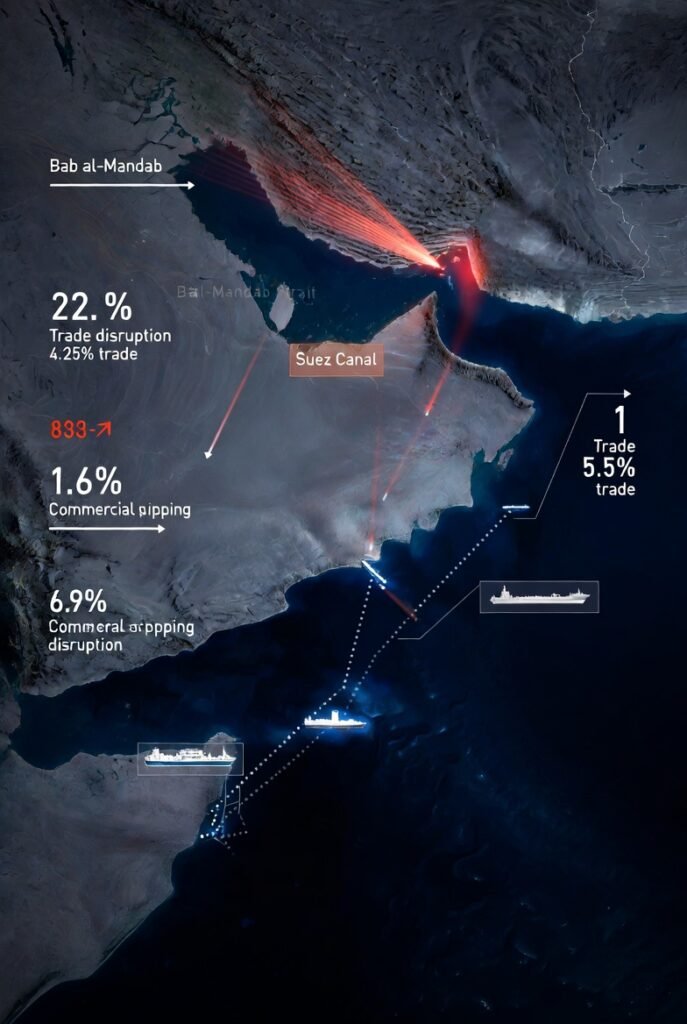
The Bab al-Mandab Strait an 18-mile chokepoint linking the Red Sea to the Gulf of Aden carries roughly 12–15% of all global maritime trade. When Houthi forces began systematically targeting vessels in 2023, it was a regional irritant. By 2026, it has become a full-scale shipping crisis with global consequences.
Major carriers have rerouted around Africa’s Cape of Good Hope, adding 10–14 days and thousands of dollars per voyage in fuel costs. Insurance premiums for Red Sea transit have reached levels not seen since the Iran-Iraq tanker wars of the 1980s, effectively pricing smaller operators out of the route entirely.
The knock-on effects extend far beyond shipping ledgers. European and Asian manufacturers relying on just-in-time supply chains have reported delays in electronics, automotive components, and consumer goods. The International Monetary Fund has formally flagged the Red Sea disruption as a downside risk to its 2026 global growth forecast. Brent crude prices have spiked, with energy analysts warning of sustained elevation should the conflict broaden further.
Key Fact
The Bab al-Mandab Strait handles an estimated 12–15% of all global trade. Liquefied natural gas shipments from Qatar — a critical European energy source also pass through these same waters. Full closure would be an economic catastrophe for three continents.
Understanding the Houthis requires understanding Iran’s ‘Axis of Resistance’ a network of proxy forces spanning Lebanon’s Hezbollah, Iraqi militias, Palestinian armed factions, and Yemen’s Ansar Allah movement. Each serves as a lever Iran can pull to apply pressure on adversaries without committing its own forces to direct engagement.
Iran supplies the Houthis with anti-ship ballistic missiles, Shahed-series drones, Quds-1 cruise missiles, and battlefield intelligence. This technology has allowed a relatively lightly equipped force to threaten some of the most powerful navies in the world a remarkable force multiplication that costs Tehran far less than conventional warfare.
For Iran, the Houthi campaign simultaneously ties down US naval assets, raises the cost of any American strike on Iranian territory, signals regional resolve, and applies economic pressure on Western governments all while maintaining plausible deniability. It is a textbook application of Iran’s asymmetric foreign policy doctrine.
For the Houthis themselves, the conflict has paradoxically strengthened their domestic standing. Years of Saudi-led coalition bombing have built a powerful resistance narrative. Framing Red Sea attacks as solidarity with Gaza has extended their appeal across the broader Arab world.
The United States faces a deeply uncomfortable strategic equation. The world’s most powerful military is engaged in a sustained air and naval campaign against a non-state actor equipped with comparatively primitive yet devastatingly effective weaponry. US and allied strikes have targeted Houthi missile infrastructure, radar installations, and drone launch sites through Operation Prosperity Guardian. Yet the group’s ability to regenerate capabilities and continue attacks has proven remarkably resilient.
Escalating strikes risk drawing Iran into direct confrontation a scenario the United States has consistently sought to avoid. Restraint, however, signals weakness to regional adversaries and emboldens further Houthi action. Neither option is without serious costs.
Diplomatically, the United States is pursuing a parallel track: tightening sanctions on Iranian entities supporting the Houthis while attempting to build a coordinated Gulf Cooperation Council security framework. Saudi Arabia’s position complicates matters Riyadh is simultaneously managing its own Yemen ceasefire process while being expected to align with US strategic objectives in the region.
China adds another critical variable. Beijing, which brokered the historic Saudi-Iran rapprochement in 2023, has significant Belt and Road infrastructure interests dependent on Red Sea stability. Whether China chooses to moderate Houthi behavior through its Tehran relationship or views US difficulties as strategic opportunity could prove decisive to how this conflict evolves.
March 29, 2026 Update Diplomatic sources indicate back-channel communications between Washington and Tehran remain active as of this reporting, focused on establishing a de-escalation framework. However, no formal ceasefire mechanism for Houthi Red Sea operations is currently in place. |
The possibility of the Yemen conflict spiraling into a broader global war must be assessed carefully neither dismissed as alarmism nor overstated as certainty. Several structural factors argue against a World War III scenario in the near term.
Nuclear deterrence continues to constrain major power behavior. Neither Washington nor Tehran has demonstrated genuine appetite for direct state-on-state military confrontation. Russia, consumed by its Ukraine war, lacks the bandwidth for Middle Eastern adventurism. China’s deep economic interdependence with the West creates powerful incentives against actively supporting a conflict that would fracture global trade.
Yet the structural risks of miscalculation are significant. A major Houthi strike killing US service members in large numbers could force presidential-level retaliation against Iran directly. An Iranian
miscalculation about American red lines or a domestic political crisis in Tehran requiring an external distraction could shatter the current uneasy equilibrium. The concentration of US, British, French, and allied naval forces in a compact maritime theater creates conditions where incidents can escalate faster than diplomacy can respond.
Honest Assessment
Yemen’s entry into the Iran-US confrontation has materially raised the structural risk of a broader regional war. A World War III scenario remains a low-probability outcome but the margin for error has narrowed significantly. The economic consequences of the current crisis, even without further military escalation, are already being felt by billions of people worldwide.
Houthi forces in Yemen are conducting sustained attacks against US naval assets and US-linked commercial shipping in the Red Sea. While the United States has not formally declared war against Yemen, active US military strikes against Houthi infrastructure are ongoing. This constitutes an active armed conflict by most definitions.
The Houthis state their attacks are a response to Israeli military operations in Gaza and are intended to pressure Israel and its Western allies. Strategically, Iran uses the Houthi campaign to tie down US naval assets and raise the cost of potential strikes on Iranian territory without direct Iranian military involvement.
The Red Sea disruption has forced major carriers to reroute around Africa’s Cape of Good Hope, adding 10–14 days and significant fuel costs per voyage. Supply chains for European and Asian manufacturers have been disrupted, oil prices have risen, and insurance costs for regional shipping have reached multi-decade highs.
Most geopolitical analysts assess a World War III scenario as low probability but structurally possible through miscalculation. The risk of accidental escalation a major strike on US forces, an Iranian miscalculation, or a rapid military incident is real. The margin for error has narrowed considerably since Yemen’s entry into the broader Iran-US confrontation.
Yemen’s entry into the Iran-US war in 2026 is not a peripheral development it is now central to the global security landscape. The Houthis have demonstrated that a motivated, externally supported non-state actor can impose enormous costs on the international system through one strategic chokepoint.
The path forward requires sustained military deterrence, genuine diplomatic engagement with Yemen’s underlying political crisis, and coordination among major powers including China to prevent the kind of miscalculation that has historically transformed regional conflicts into global ones.
The new era of Middle East war has already begun. Whether it remains regional or becomes something far more dangerous depends on decisions being made right now in Washington, Tehran, Beijing, and Sanaa.