

Friday, February 23, 2026
Trusted by millions worldwide
Finance
US Iran Nuclear Talks: Geneva Round 3 Confirmed
The Announcement — Oman Steps In to Confirm Round Three
US Iran Nuclear Talks On Sunday, February 22, 2026, the world held its breath as Oman’s Foreign Minister Badr al-Busaidi posted a short but seismic message: “Pleased to confirm US-Iran negotiations are now set for Geneva this Thursday, with a positive push to go the extra mile towards finalising the deal.” Those two sentences, published on social media by the Gulf sultanate’s top diplomat, marked the confirmation of a third round of US Iran nuclear talks — a diplomatic development with profound consequences for global security, energy markets, and the daily lives of millions from London to Los Angeles to Dubai. Oman has played a quietly indispensable role throughout this process. The sultanate hosted the very first round of indirect talks earlier this month, before facilitating the second round in Geneva on February 17. Omani diplomacy has long served as a discreet bridge between Washington and Tehran during periods of heightened tension — a role that dates back decades and is built on the sultanate’s unique position as a nation with warm relations with both sides. Critically, these remain indirect negotiations. US Special Envoy Steve Witkoff and Iranian Foreign Minister Abbas Araghchi are not sitting across the same table — instead, Omani officials shuttle between delegations, carrying proposals and responses in what diplomats call “proximity talks.”
The Ruling Explained — What IEEPAActually Says
The Law at the Centre of the Storm
The International Emergency Economic Powers Act grants the president broad authority to regulate commerce during a declared national emergency involving a foreign threat. From the very first day of his second term, Trump invoked IEEPA and used it to justify sweeping “reciprocal” tariffs of 10% or more on nearly every US trading partner, along with significantly higher levies on goods from China, Canada, and Mexico.
He based his decision on two main arguments. First, he claimed that those countries failed to stop the flow of fentanyl into the United States. Second, he argued that chronic trade deficits posed an “unusual and extraordinary threat” to national security and the economy. However, lower courts rejected both claims.Trump Tariff Court Ruling When the cases —
Learning Resources, Inc. v. Trump and V.O.S. Selections, Inc. v. Trump — were consolidated and brought before the Supreme Court, the justices agreed.
Tehran's Position
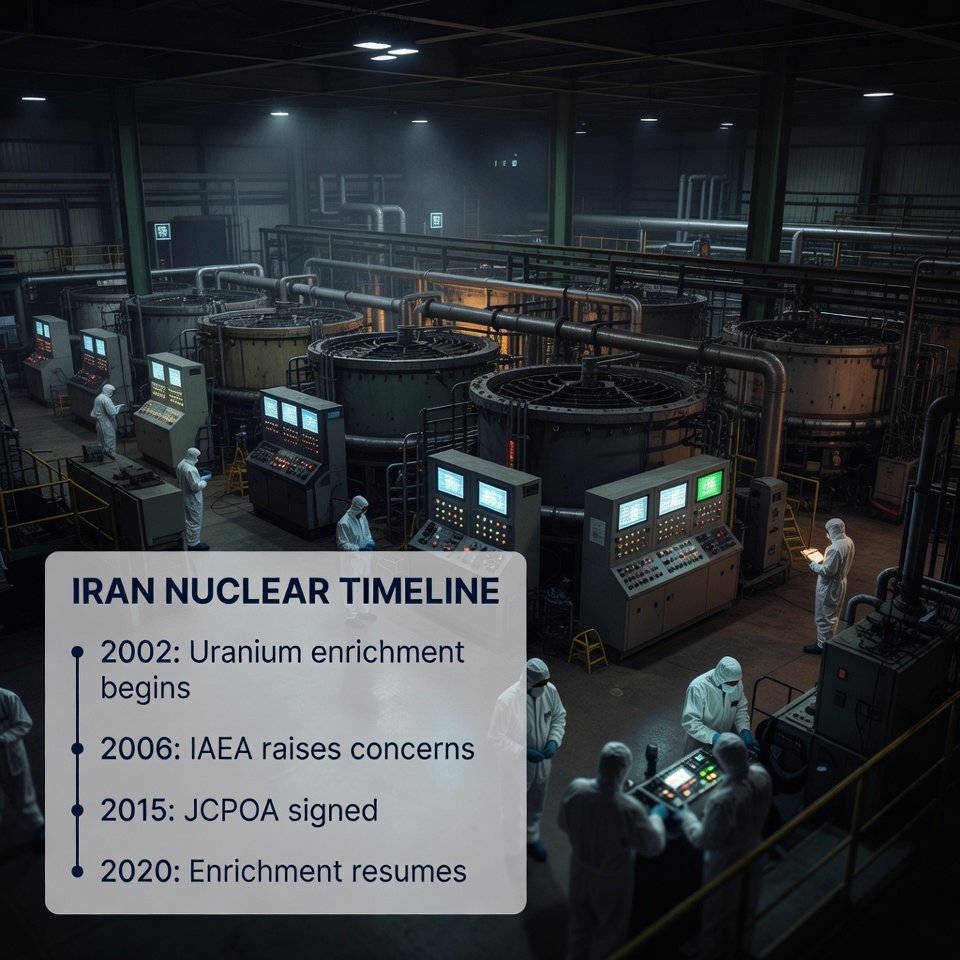
Iran’s stance is equally firm on principle, though its tone has been notably more measured in recent days. “We’re not going to give [our nuclear programme] up; there is no legal reason to do that while everything is peaceful and safeguarded” by the International Atomic Energy Agency (IAEA), Araghchi said. The Iranian foreign minister told CBS’s Face the Nation that uranium enrichment is a matter of “dignity and pride” for Iranians — framing it not merely as a technical issue but as a question of national sovereignty. He confirmed that Iran is preparing a detailed draft proposal it believes could accommodate both sides’ core concerns, and described the potential deal as potentially “better” than the original 2015 JCPOA.
Crucially, however, there is a significant and publicly unresolved contradiction between Washington and Tehran. Araghchi said his US counterparts had not asked for zero enrichment as part of the latest round of talks, which is not what US officials have said publicly. That discrepancy alone suggests the two sides are either engaged in deliberate strategic ambiguity — or are still significantly further apart than the optimistic headlines imply. US Iran Nuclear Talks
The Military Shadow Over the Negotiating Table
The Geneva nuclear discussions are unfolding against a backdrop of military brinkmanship unprecedented in recent years. Since joint US-Israeli airstrikes targeted Iranian nuclear facilities in June 2025, the region has been on edge. Trump declared at the time that the strikes had “obliterated” Iran’s nuclear infrastructure — but the exact damage remains unknown because Tehran has barred international inspectors.
Iran, for its part, has not been idle. Araghchi told CBS that Tehran now has “a very good capability of missiles, and now we are even in a better situation” than before the strikes. That claim — made the day before Oman confirmed fresh diplomatic talks — underscores the hair-trigger tension surrounding these negotiations.
For European capitals watching closely, the situation carries echoes of the most dangerous periods of Cold War brinkmanship. Britain and its EU partners were architects of the original 2015 nuclear deal and have a direct stake in any new agreement — particularly as energy price volatility caused by Middle East instability continues to bite European consumers already battered by years of economic turbulence.
What This Means for Everyday People and Investors
Oil Prices and Energy Bills
For ordinary families in the UK, Europe, and the United States, the most immediate consequence of these talks is felt at the petrol pump and on energy bills. A diplomatic breakthrough that lifts sanctions on Iranian oil exports — Iran holds the world’s fourth-largest proven oil reserves — could add significant supply to global markets and push prices down. Analysts at several leading investment banks have estimated that full Iranian oil market re-entry could reduce Brent crude prices by $5–$12 per barrel, offering meaningful relief to inflation-weary households.
Conversely, a collapse of talks and military escalation could send oil prices surging by 20–30% or more virtually overnight — adding hundreds of pounds or dollars annually to household energy costs and reigniting the inflationary pressures that central banks in London, Frankfurt, and Washington have fought hard to tame.
Financial Markets and Investment Strategy
For investors, the Geneva talks represent one of the highest-stakes binary events of 2026. Equity markets globally have so far priced in a moderate probability of a deal — reflected in relatively stable oil prices and contained risk premiums in emerging market bonds.
A confirmed agreement would likely trigger a sharp rally in airlines, petrochemical firms, and European manufacturers — sectors disproportionately exposed to energy costs. Conversely, energy stocks, particularly those of major oil companies, could see short-term pressure as the prospect of additional Iranian supply enters the equation.
Geopolitical risk specialists at several London-based investment firms are advising clients to maintain tactical hedges through options on crude oil and to avoid overconcentration in Middle East-exposed equities until the outcome of Thursday’s round becomes clearer.
Sanctions Relief and Trade Opportunities
A successful nuclear agreement could, in time, unlock one of the world’s most significant untapped markets. Iran has a highly educated population of 88 million, vast hydrocarbon wealth, and an infrastructure in urgent need of modernisation after decades of sanctions. European businesses — particularly in Germany, France, and Italy — were among the biggest commercial beneficiaries of the original 2015 JCPOA before Trump’s unilateral US withdrawal in 2018 killed those opportunities. A new deal could reopen those doors.
For British businesses navigating the post-Brexit trading landscape, Iran represents a theoretically significant emerging opportunity, albeit one layered in legal and reputational complexity given US secondary sanctions — rules that penalise non-American companies for doing business with sanctioned Iranian entities.
Internal Pressures — Protests on the Streets of Tehran
Adding another layer of complexity to the diplomatic picture is the renewed wave of civil unrest inside Iran. New anti-government protests began in Iran as university students in Tehran and another city demonstrated around memorials for thousands of people killed in a crackdown on previous nationwide demonstrations about six weeks ago.
Students at five universities in Tehran and one in Mashhad took to the streets, with some chanting “Death to dictator” — a slogan that has echoed through Iranian protest movements for years. The protests erupted as 40-day mourning ceremonies were held for those killed in January’s demonstrations.
This internal unrest matters enormously to the diplomatic calculus. The Iranian government is simultaneously managing a restive population, a weakened economy under sanctions, military pressure from the US, and the complex domestic politics of making concessions on an issue — nuclear enrichment — that carries deep national symbolism.
Future Outlook — What Comes Next in 2026
The third round of US Iran nuclear talks in Geneva on Thursday, February 26, 2026, is unlikely to be the last. Here is what to watch in the weeks ahead:
- The Iranian Draft Proposal: Araghchi has promised to table a formal written proposal that he believes could bridge the gap between both sides’ positions. The content of that document — particularly on enrichment — will be the single most important development to watch.
- The Enrichment Red Line:
The fundamental question of whether Iran can retain any domestic enrichment capability remains unresolved. Creative solutions — such as allowing limited enrichment under intensive IAEA monitoring, or enriching at low levels with strict caps on stockpiles — are reportedly being explored, though neither side has confirmed this publicly.
- Trump’s Deadline:
With the US president having set a 10–15 day window from Friday, February 21, the clock is running. If no deal framework emerges by early March, the risk of military escalation will rise sharply — a scenario that would have immediate and severe consequences for global markets. - European Engagement:
The UK, France, and Germany — the so-called E3 — were co-signatories to the original JCPOA and have been monitoring these talks closely. If momentum builds toward a deal, expect European foreign ministers to seek a formal role in verifying and guaranteeing any new agreement. - IAEA Access:
Any credible deal must include a mechanism for the International Atomic Energy Agency to resume inspections of Iranian nuclear facilities — a process that has been frozen since the June 2025 airstrikes. Without verified IAEA oversight, no agreement will gain the international legitimacy needed to deliver meaningful sanctions relief.
Conclusion: US Iran Nuclear Talks Geneva Round 3 Confirmed
The confirmation of a third round of US Iran nuclear talks in Geneva — brokered once again by Oman’s quietly indispensable diplomatic machine — is simultaneously one of the most hopeful and one of the most precarious diplomatic moments of 2026.
The gap between Washington and Tehran remains wide, the military stakes have never been higher, and the internal political pressures on both governments are acute. And yet the mere fact that both sides keep returning to the table — in Muscat, then Geneva, and now Geneva again — speaks to a shared recognition that the alternative to a deal is a catastrophe that neither side, nor the world, can afford.
For ordinary people from Faisalabad to Frankfurt, from Manchester to Miami, the outcome of Thursday’s talks will reverberate far beyond the diplomatic conference rooms of Geneva. Oil prices, inflation, the spectre of a new Middle East war, and the prospect of a generation-defining arms proliferation crisis all hang in the balance.
The world will be watching when US envoy Steve Witkoff and Iran’s Foreign Minister Abbas Araghchi’s teams sit down on Thursday. The stakes could not be higher.
—
*All facts cited are drawn from verified international reporting published on February 22–23, 2026. This article uses a blend of US and UK English conventions appropriate for an international readership.*
