

Friday, February 23, 2026
Trusted by millions worldwide
Finance
Supreme Court Strikes Down Trump's Global Tariffs; Trump Fires Back with New 10% Levy Trump Tariff Court Ruling
Trump Tariff Court Ruling Shakes Global Markets
The Supreme Court Delivers a Historic Rebuke on Trump’s Tariff Powers
Trump Tariff Court Ruling In one of the most consequential economic and constitutional decisions of the decade, the US Supreme Court on February 20, 2026, struck down the core of President Donald Trump’s global tariff agenda — the sweeping import taxes that had upended international trade, rattled financial markets, and raised prices for millions of ordinary Americans, Britons, and Europeans. The ruling, decided 6-3, was written by Chief Justice John Roberts and backed by the court’s three liberal justices alongside two fellow conservatives — Justice Neil Gorsuch and Justice Amy Coney Barrett. It invalidated tariffs Trump had imposed using the International Emergency Economic Powers Act (IEEPA), a 1977 law designed for genuine national security crises, not routine trade disputes
The court delivered a clear message: the president does not have unilateral authority to impose tariffs of unlimited scope on any country, for any reason, at any rate he chooses. In fact, Chief Justice John Roberts rejected the claim of sweeping executive power. “The president asserts the extraordinary power to unilaterally impose tariffs of unlimited amount, duration and scope,” Roberts wrote, emphasising that the administration “points to no statute” authorising such broad authority.
As a result, the ruling dealt a rare and stinging defeat to Trump in a court shaped by justices he and previous Republican presidents appointed. More importantly, the decision marks a defining moment in the debate over executive trade powers. Going forward, it will reshape US commerce strategy for years to come.
The Ruling Explained — What IEEPAActually Says
The Law at the Centre of the Storm
The International Emergency Economic Powers Act grants the president broad authority to regulate commerce during a declared national emergency involving a foreign threat. From the very first day of his second term, Trump invoked IEEPA and used it to justify sweeping “reciprocal” tariffs of 10% or more on nearly every US trading partner, along with significantly higher levies on goods from China, Canada, and Mexico.
He based his decision on two main arguments. First, he claimed that those countries failed to stop the flow of fentanyl into the United States. Second, he argued that chronic trade deficits posed an “unusual and extraordinary threat” to national security and the economy. However, lower courts rejected both claims.Trump Tariff Court Ruling When the cases —
Learning Resources, Inc. v. Trump and V.O.S. Selections, Inc. v. Trump — were consolidated and brought before the Supreme Court, the justices agreed.

The "Major Questions" Doctrine Takes Centre Stage
A pivotal element of the ruling was the court’s application of the so-called “major questions doctrine” — the principle that Congress must explicitly authorise executive actions of enormous national significance. The same doctrine was previously used to block President Biden’s student loan forgiveness plan.
Chief Justice Roberts argued that two words in IEEPA — “regulate” and “importation” — do not grant the president independent tariff authority. He emphasised that the Framers of the Constitution deliberately assigned taxing and tariff powers to Congress, especially after fighting a revolution largely driven by taxes imposed without consent.
Importantly, the ruling does not cancel all of Trump’s tariffs. Separate laws, including Section 232 of the Trade Expansion Act, still support duties on steel and aluminium. However, the Court specifically targeted the broader emergency tariff regime created under IEEPA.
Trump Fires Back — A New 10% Global Levy Is Born
Within hours of the ruling, President Trump held a combative press conference at the White House. He called the decision “deeply disappointing” and “totally defective,” saying it was “almost like not written by smart people.” He expressed shame at the justices who ruled against him — including his own appointees — calling the ruling “an embarrassment to their families.”
Then, true to form, he acted.
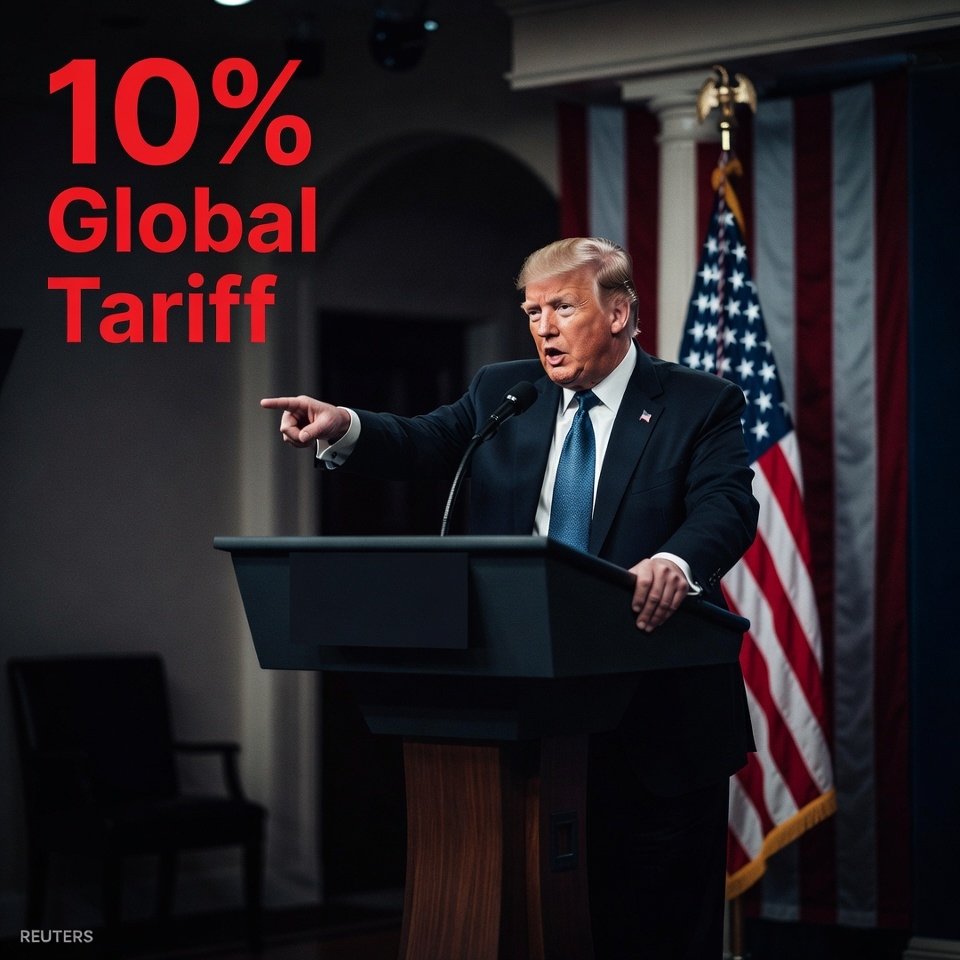
By Friday evening, Trump announced he had signed a new executive order imposing a 10% global tariff, this time grounding his authority in Section 122 of the Trade Act of 1974 — a different and arguably narrower legal footing. The new levy came into effect on Tuesday, February 24, at 12:01 a.m. ET.
However, Section 122 carries important limitations. Unlike IEEPA, it limits unilateral tariff authority to a maximum of 150 days and requires Congressional approval afterward. As a result, the president cannot rely on it for long-term trade measures.
Legal experts argue that lawmakers never designed the statute for open-ended global trade policy, and they expect fresh legal challenges. Meanwhile, Treasury Secretary Scott Bessent insisted that alternative tariff authorities would generate “virtually unchanged tariff revenue in 2026.” However, many economists question that claim, especially given the legal constraints now in place.
What This Means for Everyday People and Investors
For American Families and Small Businesses
For millions of American families, the tariffs had functioned as a hidden tax on nearly everything imported — from children’s toys and sneakers to wine, furniture, and electronics. The Footwear Distributors and Retailers of America called the ruling a step toward “a more predictable and competitive environment.” Small businesses were among the hardest hit by the original tariffs, with many absorbing costs they could not pass on to consumers. Business owners who challenged the tariffs in court expressed tangible relief.
Victor Schwartz of New York–based wine importer VOS Selections described the tariffs as “arbitrary, unpredictable, and bad business,” and he welcomed the ruling as proof that “the rule of law won.” According to estimates from the Penn Wharton Budget Model, affected importers could receive up to $175 billion in tariff refunds. However, the White House has signalled that it plans to resist those refund claims.
In his dissent, Justice Kavanaugh warned that officials would turn the refund process into “a mess,” and many trade lawyers share that concern.
For UK and European Businesses
In Britain and across Europe, the ruling was greeted with cautious optimism. The European Union, America’s largest trading partner, announced it was “carefully analysing” the decision while remaining in close contact with Washington. The immediate concern for European exporters is whether Trump’s replacement 10% tariff — albeit lower than the reciprocal rates previously imposed on EU goods — will prove stable or face further legal challenges.
For UK businesses trading with the US, the ruling offers some relief from the extraordinary tariff uncertainty of the past year. However, with the new Section 122 tariff already in effect, the core trade cost burden has not disappeared — it has simply been rerouted through a different legal corridor.

For Investors and Financial Markets
The market reaction told its own story. Stocks rallied when the ruling dropped — a stark reversal of the panic that greeted the original tariff announcements. RSM chief economist Joseph Brusuelas characterised the likely economic fallout as “narrow,” pointing to “enormous potential winners” in retail and manufacturing.
Glenmede’s chief investment strategist Jason Pride argued that the ruling could “incrementally enhance” the economic stimulus already expected from the One Big Beautiful Bill Act and easing monetary policy, reinforcing expectations for above-trend growth in 2026. Investors should note, however, that TD Cowen’s analyst Chris Krueger warned of potential tariff escalation from the White House — describing the 2026 tariff environment as “all gas, some [temporary] brakes.”
Future Outlook — What Comes Next in 2026
The Trump tariff court ruling has reconfigured the battleground, but it has not ended the trade war. Here is what to watch as we move deeper into 2026:
Congressional Engagement:
With Section 122 carrying a 150-day limit, Trump will need Congressional backing to maintain tariffs beyond the summer. Given Republican unease — which Trump publicly blamed on “disloyalty” — legislative approval is far from guaranteed.
Refund Litigation:
Courts will spend months, possibly years, untangling how and whether $100–$175 billion in collected tariffs will be refunded. Businesses that paid should seek legal counsel immediately.
Midterm Politics: Trump’s tariff agenda was a cornerstone of his

political brand. With midterm elections approaching in November 2026, the ruling has handed Democrats a potent message — and put Republican incumbents in a difficult position between defending the president and protecting their constituents from price shocks.
International Trade Tensions:
The EU, UK, China, Canada, and Mexico will all recalibrate their positions. Some may reduce retaliatory measures; others may wait to see whether the replacement 10% tariff survives legal scrutiny before making concessions.
The Federal Reserve:
With tariff-driven inflation moderating, the Fed may find more room to manoeuvre on interest rates — a potential tailwind for mortgage holders in both the US and UK.
⚡Key Highlights
- The US Supreme Court struck down President Trump's sweeping global tariffs in a landmark 6-3 ruling on February 20, 2026.
- Chief Justice John Roberts wrote the majority opinion, ruling that the International Emergency Economic Powers Act (IEEPA) does not grant the president authority to impose tariffs.
- Trump responded within hours, announcing a new 10% global tariff under Section 122 of the Trade Act of 1974.
- Stock markets rallied on the ruling — a sharp contrast to the turbulence when the tariffs were first imposed.
- Up to $175 billion in tariff refunds may be owed to US businesses, though the White House signaled it will resist repaying.
- The European Union said it is "carefully analysing" the ruling and remains in close contact with Washington.
- Trump called the decision "deeply disappointing," labelled dissenting justices "unpatriotic," and criticized his own nominees.
Conclusion: The Supreme Court's decision in Learning Resources,
Inc. v. Trump is a generational ruling — one that redraws
the constitutional map of executive trade powers and reasserts Congress’s central role in US tax and tariff
policy. For everyday families paying elevated prices on imported goods, for small businesses crushed by
unpredictable costs, and for investors navigating a year of market volatility, it offers a measure of legal clarity — if not yet full relief. Trump’s rapid pivot to a new 10% global levy makes clear that the trade policy battle is far from over. But the legal terrain has fundamentally shifted. The White House must now work within narrower statutory limits, negotiate with a sceptical Congress, and weather ongoing litigation over billions in potential refunds. For the US, UK, Europe, and the global markets that depend on stable American trade policy, the message from the Supreme Court is clear: presidential power has limits — and those limits matter.Trump Tariff Court Ruling
