Global War Crisis 2026: Middle East Conflict Spreads to Europe & America
monday, March 30, 2026 Trusted by millions worldwide Back to News Politics Global War Crisis 2026: Middle East Conflict Spreads...
Read More → 

Wednesday, March 18, 2026
Trusted by millions worldwide
Wikipedia, Congress.gov (CRS R45281), CNBC, NPR, Al Jazeera, Kpler, FactCheck.org
Key Highlights
The Strait of Hormuz closure 2026 has pushed a piece of geography that most people had never thought about to the very top of the global economic agenda. Understanding why requires understanding what this waterway actually is and why nothing else can replace it.
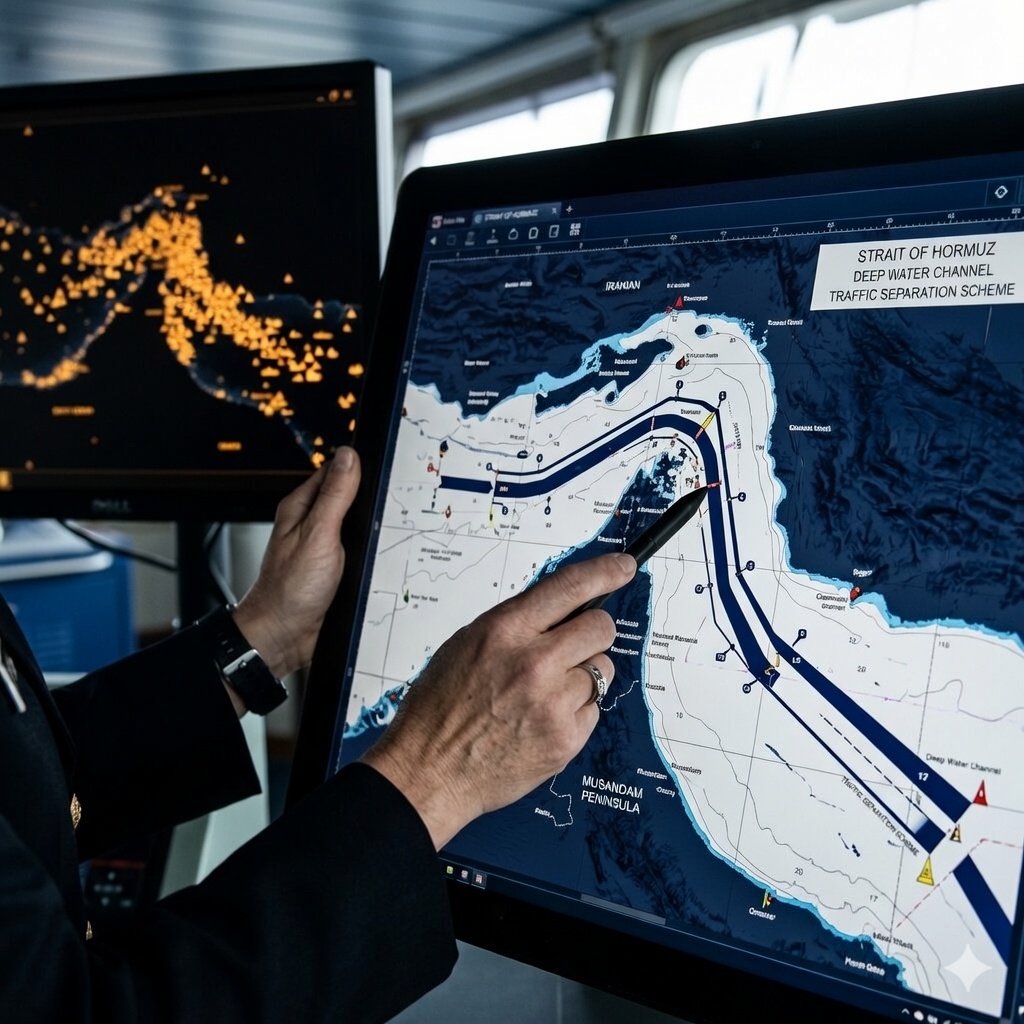
The Strait of Hormuz is a narrow stretch of water between Iran to the north and Oman’s Musandam Peninsula to the south. It is approximately 104 miles long and, at its narrowest navigable point, only about 21 miles wide. It is the only sea passage connecting the Persian Gulf and the eight countries that border it to the open ocean. There is no other way out.
In 2025, approximately 20 million barrels of crude oil and petroleum products passed through the Strait every single day. That represents roughly 20–21% of all the oil consumed worldwide. Additionally, 20% of the world’s liquefied natural gas supply transits the waterway primarily from Qatar, the world’s largest LNG exporter. Roughly one-third of global fertiliser trade also passes through. When analysts describe Hormuz as the world’s single most important energy chokepoint, these numbers explain why.
20 million barrels of oil per day transit Hormuz (2025 average) (Wikipedia / Kpler)
20% of global LNG supply exits via Hormuz including Qatar’s exports (Kpler / CNBC)
~33% of global fertiliser trade transits the Strait of Hormuz (CNBC / Bannockburn)
On March 2, 2026, a senior IRGC official announced on Iranian state media: ‘The strait of Hormuz is closed.’ Any ship attempting to pass would be ‘set ablaze.’ This was not, in a strict legal sense, a formal naval blockade — Iran did not formally declare one under international maritime law. However, the practical effect was identical.
Tanker traffic had already begun collapsing before the formal announcement. By March 4, shipping data from Kpler showed tanker transit had dropped approximately 70%. Shortly afterward, traffic fell to near-zero. Over 150 ships anchored outside the strait to wait out the crisis. Maersk and Hapag-Lloyd suspended their Middle East routes entirely.
Furthermore, on March 5, the IRGC refined its position: the closure applied specifically to vessels from the US, Israel, and their Western allies. Ships from Turkey, India, Saudi Arabia, and China subsequently obtained permission for specific transits. By March 13, a Turkish vessel, two Indian-flagged gas carriers, and a Saudi oil tanker carrying 1 million barrels for India had successfully passed. Nevertheless, insurance markets did not relent — most commercial vessels still cannot obtain war risk coverage for a Hormuz transit regardless of their flag.
Here is the strategic insight that makes the 2026 Strait of Hormuz crisis historically unique: Iran did not need a naval blockade, underwater mines, or anti-ship missiles to halt global oil shipping. It used cheap drones.
All Iran had to do was several drone strikes in the vicinity of the Strait of Hormuz. And all of a sudden, insurers and shipping companies decided that it was unsafe to traverse that very narrow S-curve of that waterway.
Helima Croft, Global Head of Commodity Strategy, RBC Capital Markets NPR, March 4, 2026
Kevin Book, co-founder of the research firm Clearview Energy Partners, told NPR: ‘When analysts have looked at the things that could go wrong in global oil markets, this is about as wrong as things could go at any single point of failure.’ The drone tactic is cost-asymmetric: Iran spent relatively little to deploy its drone capability, while the economic cost to the global economy of the resulting closure has been measured in trillions of dollars of market value.
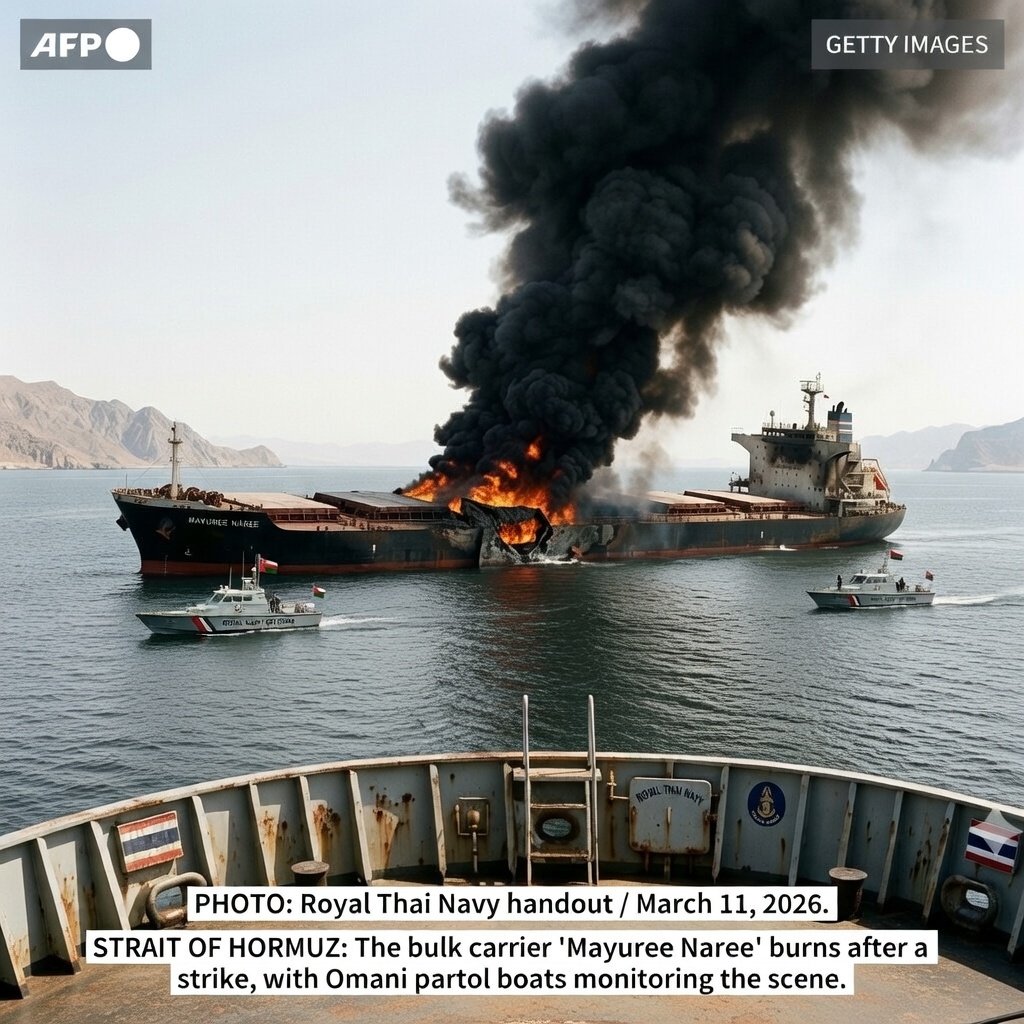
As of March 12, Iran had conducted 21 confirmed attacks on merchant ships. The oil tanker Skylight was struck north of Khasab, Oman on March 1, killing two Indian crew members. The MKD Vyom was struck by a drone boat, sparking a fire and explosion in its engine room; 21 crew evacuated. The LCT Ayeh suffered an Indian crew member critically wounded. The Thai bulk carrier Mayuree Naree burned visibly in the strait photographs of the vessel ablaze circulated widely and accelerated the collapse in shipping confidence.
21 confirmed Iranian attacks on merchant ships as of March 12, 2026 (Wikipedia / UK MTO)
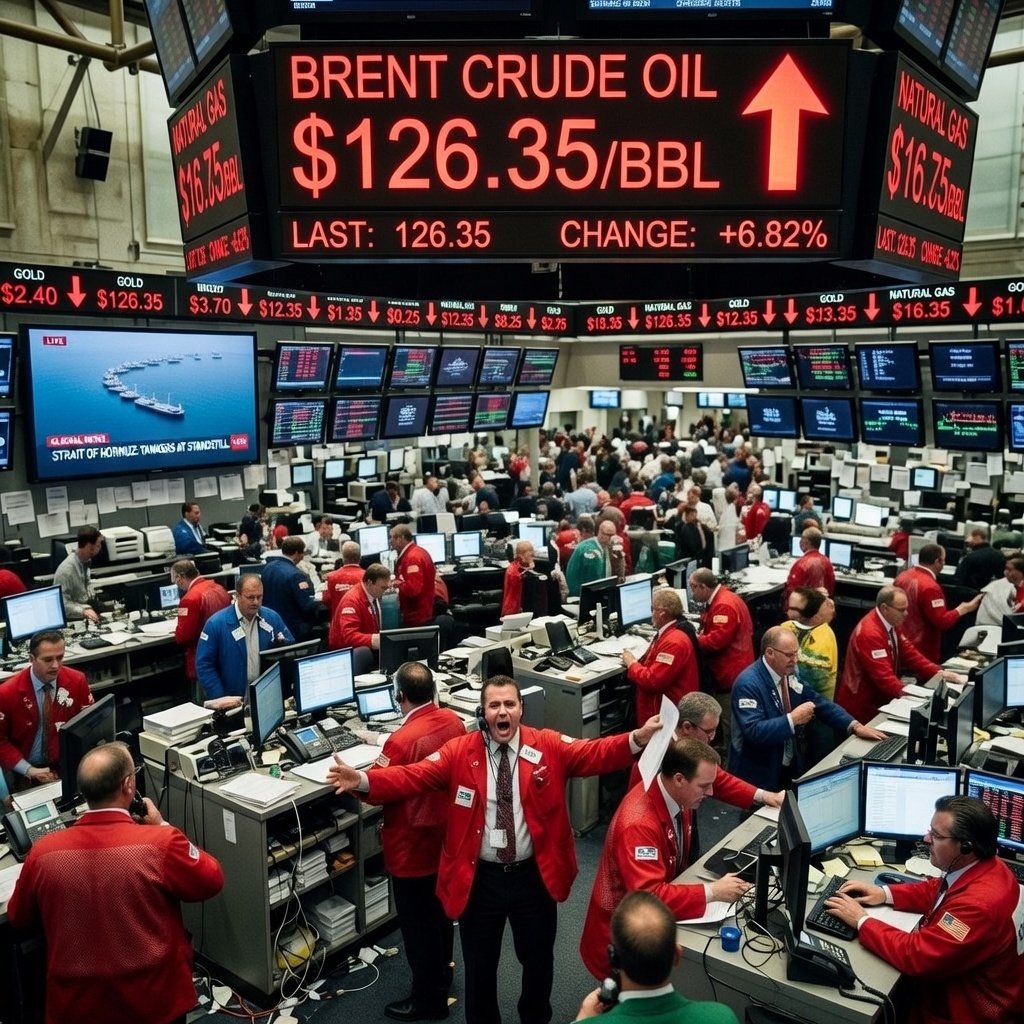
$126/bbl Brent crude peak price highest in four years reached during the crisis
On March 9, US Energy Secretary Chris Wright posted on X that the first tanker had been successfully escorted through the Strait of Hormuz by the US Navy. Markets moved immediately the announcement was taken as a signal that the waterway was reopening.
Within hours, the post was deleted. The White House confirmed the claim was incorrect. No tanker had been officially escorted through. Military experts subsequently explained why full escort operations remain impractical: while Iran’s submarine threat has likely been neutralised, its drone, ballistic missile, and cruise missile capacity remains operational. As Rear Admiral Mark Montgomery (ret.), now at the Foundation for Defense of Democracies, told NPR: ‘You can’t prevent every ballistic missile, cruise missile or drone attack.’ In the confined geometry of the Persian Gulf only a few hundred miles across at its widest defending a commercial tanker in transit against that combined threat is a task that requires resources and sustained operations that the US Navy has not yet fully deployed.
The consequences of a prolonged Strait of Hormuz closure extend far beyond oil prices. Here is what markets and supply chains are actually facing as of March 18, 2026.
Brent crude surpassed $100 per barrel on March 8 for the first time in four years, reaching a peak of $126 per barrel before settling back. US gas prices rose by more than 50 cents per gallon in the first two weeks of the conflict hitting a national average of $3.57 per gallon and climbing further. President Trump claimed on March 9 that the closure ‘doesn’t really affect’ the United States the way it does other countries, citing low direct US imports from the Persian Gulf.
This claim was rated misleading by FactCheck.org. Mark Finley, nonresident fellow in energy and global oil at Rice University’s Baker Institute, told them: ‘The US is definitely affected. Because it’s a global oil market if something goes wrong anywhere, the price goes up everywhere.’ Iraq was forced to shut down production in some of its largest oil fields because, without Hormuz access, it had nowhere to send its crude.
One-third of global fertiliser trade transits the Strait of Hormuz. Urea prices have already risen from $475 per metric ton to $680 per metric ton a 43% increase. Darrell Fletcher, managing director of commodities at Bannockburn Global Forex, described it as ‘not great timing for the planting window in the Midwest for soy and corn.’ If fertiliser shipments remain blocked through the spring planting season, food inflation in the US and globally could accelerate significantly a downstream consequence most media coverage has undercovered.
Additionally, 85% of polyethylene exports from the Middle East pass through Hormuz. Usha Haley, professor and supply chain expert at Wichita State University, told CNBC that ‘shortages and backlogs will raise the price of packaging, automotive components, and consumer goods.’ Furthermore, 30% of Europe’s jet fuel supply originates in or transits via the Strait. European airlines have begun contingency planning for sustained supply shortfalls.
Asia faces the maximum pain, according to Nomura’s March 2026 research note. India, Thailand, South Korea, the Philippines, and Japan are identified as most vulnerable due to their high oil import dependence and proximity to Gulf supply chains. Pakistan sources 99% of its LNG from Qatar and the UAE; Bangladesh 72%; India 53%. Qatar the world’s largest LNG exporter halted production after Iranian drones struck its Ras Laffan and Mesaieed industrial facilities.
China is materially exposed but more flexible. Roughly 40% of its oil imports transit Hormuz, and 30% of its LNG comes from Qatar and the UAE. However, China holds 7.6 million tons of LNG in inventory and can pivot rapidly to Russian crude. Consequently, Russia is the conflict’s principal indirect beneficiary: higher oil prices boost Moscow’s energy revenue at precisely the moment European sanctions are attempting to restrict it.
The short answer to both questions is: yes, but with severe limitations.
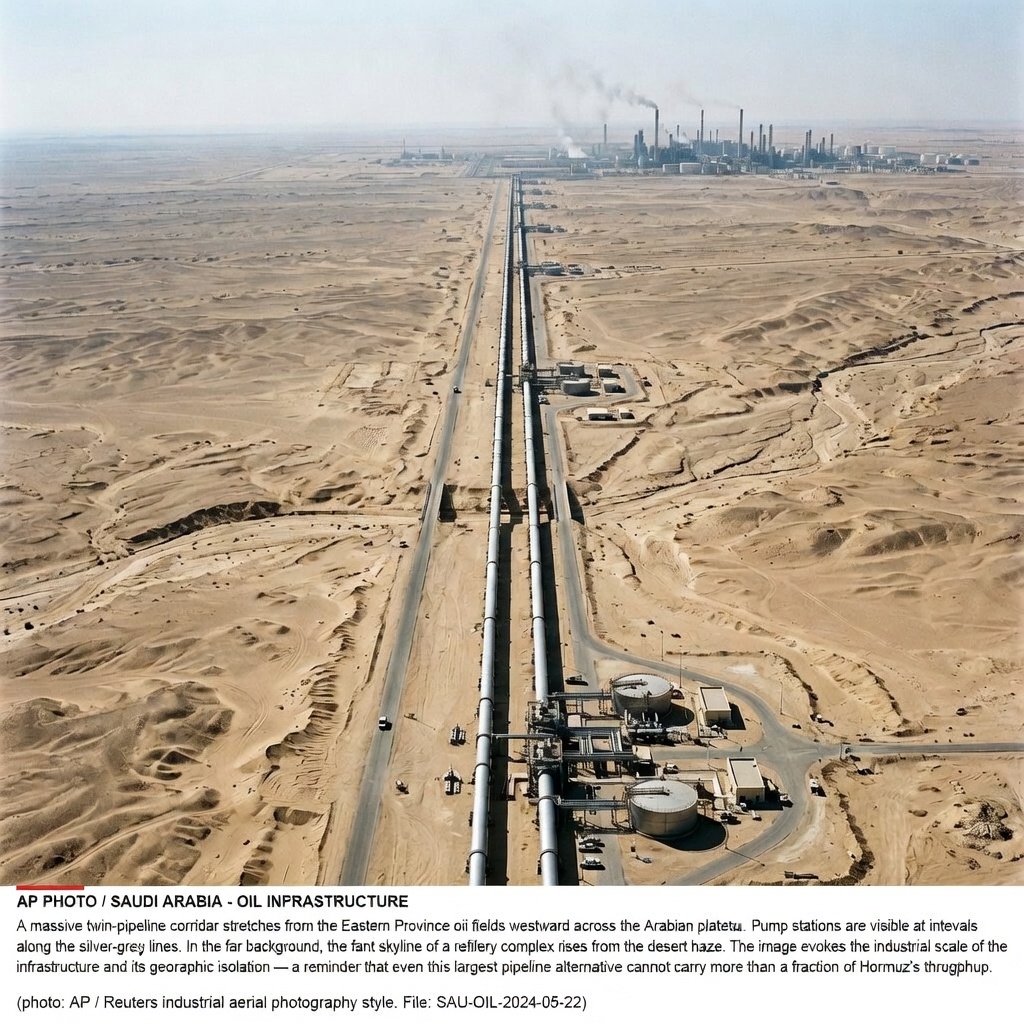
Two onshore pipeline routes exist. Saudi Arabia’s East-West Crude Oil Pipeline runs from its eastern oil fields to the Red Sea port of Yanbu, with a capacity of approximately 7 million barrels per day. Saudi Arabia began significantly increasing diversions via this route from March 10 onwards. The UAE’s Abu Dhabi Crude Oil Pipeline (Habshan-Fujairah pipeline) routes oil to the port of Fujairah on the Arabian Sea, bypassing the Strait entirely.
However, the arithmetic is unforgiving. All onshore pipeline capacity combined across Saudi Arabia, the UAE, and the Iraq Pipeline through Saudi Arabia (1.65 million b/d) totals approximately 3 to 5.5 million barrels per day. Hormuz normally carries 20 million. The gap cannot be bridged. Furthermore, Oman’s alternative deep-water ports of Duqm, Salalah, and Sohar have all been struck by Iranian drones since March 2026. Sohar has been classified within insurer war risk zones, increasing costs prohibitively.
Three scenarios could reopen the Strait. The first is a ceasefire or diplomatic agreement between the US and Iran the fastest and most complete solution, but one that requires political will Washington has not yet demonstrated. The second is a decisive US military operation that eliminates Iran’s drone, mine, and missile capability within the Gulf which military analysts say would require weeks of sustained operations and would carry significant escalation risk. The third is a partial normalisation in which insurance markets gradually return coverage as perceived risk decreases a slower process that could take months even after physical fighting ends.
The IEA’s emergency release of 400 million barrels from member nations’ reserves, combined with Trump’s 172 million barrel SPR release, provides a buffer of approximately 3.3 million barrels per day of additional supply over 120 days. JPMorgan and Goldman Sachs both project that this is insufficient to offset the full Hormuz disruption. Goldman maintained its $150 per barrel scenario through end of March before backing away from the upper bound; JPMorgan maintained $130 through Q2 2026.
The Strait of Hormuz closure 2026 has produced what Helima Croft of RBC Capital Markets calls ‘the biggest energy crisis since the oil embargo in the 1970s’ and what Kevin Book describes as ‘about as wrong as things could go at any single point of failure.’ The closure was achieved not with mines or naval power, but with cheap drones and the rational response of insurance markets to perceived risk. Twenty million barrels per day have been effectively removed from global circulation. Oil hit $126 per barrel. Fertiliser prices are up 43%. Qatar’s LNG output was disrupted. Iraq shut down its oil fields.
Furthermore, the alternative routes cannot replace the missing volume. Onshore pipelines carry a quarter of what Hormuz moves on its quietest day. Oman’s bypass ports have been struck. US Navy escort operations have not yet begun despite a premature White House announcement. And Iran’s new Supreme Leader Mojtaba Khamenei has stated publicly that the Gulf should remain closed.
Consequently, as of March 18, 2026 Day 18 of the Iran war the Strait of Hormuz remains effectively closed to Western commercial shipping. Whether it reopens in days, weeks, or months depends on decisions being made in Washington, Tehran, and Oman that the markets are watching with unprecedented intensity. Until those decisions produce a result, the world’s most important 21-mile waterway remains the most consequential closed door on the planet.
Sources: Wikipedia (2026 Strait of Hormuz Crisis) · Congress.gov CRS Report R45281 · CNBC (March 11 & March 3, 2026) · NPR (March 4 & March 12, 2026) · Al Jazeera (March 3) · Kpler Maritime Intelligence · FactCheck.org (March 14) · Wikipedia (Strait of Hormuz) | Published March 18, 2026


 Optimized by Seraphinite Accelerator