Global War Crisis 2026: Middle East Conflict Spreads to Europe & America
monday, March 30, 2026 Trusted by millions worldwide Back to News Politics Global War Crisis 2026: Middle East Conflict Spreads...
Read More → 

Monday, March 16, 2026
Trusted by millions worldwide
VERDICT: FALSE Benjamin Netanyahu is alive. All claims suggesting he was killed or injured in an Iranian strike are false. His office has confirmed: ‘These are fake news; the Prime Minister is fine.’
Key Highlights
Benjamin Netanyahu is alive. That is the unambiguous, officially confirmed, documented answer to what became for approximately 72 hours from March 13 to 15, 2026 one of the most-searched questions on social media platforms worldwide. The viral claim that Netanyahu had been killed or seriously injured in an Iranian missile strike during the ongoing Israel-Iran war has been formally and comprehensively debunked, and the Israeli Prime Minister himself delivered the most definitive rebuttal possible.
On March 14–15, Netanyahu appeared in a video on social media, relaxed and visibly amused, sipping a cup of coffee and addressing the rumours directly. ‘I am still alive,’ he said laughing off the speculation that had swept across X, TikTok, Facebook, and WhatsApp groups in dozens of languages over the preceding 48 hours. Furthermore, on March 12, before the rumour reached its peak, he had already appeared at a live press conference broadcast simultaneously on X and by multiple international news networks, answering questions and delivering a statement on the conflict. It is difficult to assassinate a man who holds a televised press conference.
Nevertheless, the episode reveals something important about the information environment of modern wartime: rumours about the deaths of national leaders are not merely organic products of public anxiety. They are strategic weapons. And in this case, the weapon was forged in Tehran.
These are fake news; the Prime Minister is fine.
— Israeli Prime Minister’s Office, responding to Anadolu Agency — March 15, 2026
The rumour did not begin on X or TikTok. Tracing it to its origin, both the Jerusalem Post and Snopes identified Iran’s Tasnim News Agency as the primary source. Tasnim published a Persian-language report in early March 2026 assembling a series of circumstantial observations: the absence of recent video clips of Netanyahu, reports of tightened security around his home, a postponed visit by Jared Kushner and US special envoy Steve Witkoff, and a French readout of a call between President Macron and Netanyahu that did not specify the date of the conversation.
Critically, none of these observations constituted evidence of a strike on Netanyahu. No video of an impact on his residence or convoy was provided. No Israeli medical or security source corroborated any injury. Tasnim presented insinuation as narrative and circulated it as if it pointed to a hidden event.The source matters enormously. Tasnim News Agency is widely described by analysts as affiliated with or close to Iran’s Islamic Revolutionary Guard Corps. The US Treasury has formally listed the outlet as linked to the IRGC. Consequently, this was not idle speculation by curious social media users. It was a calculated piece of wartime information warfare a psychological operation designed to destabilise Israeli public confidence, create confusion among Western audiences, and generate the appearance of a leadership vacuum in Jerusalem at a moment of maximum geopolitical tension.
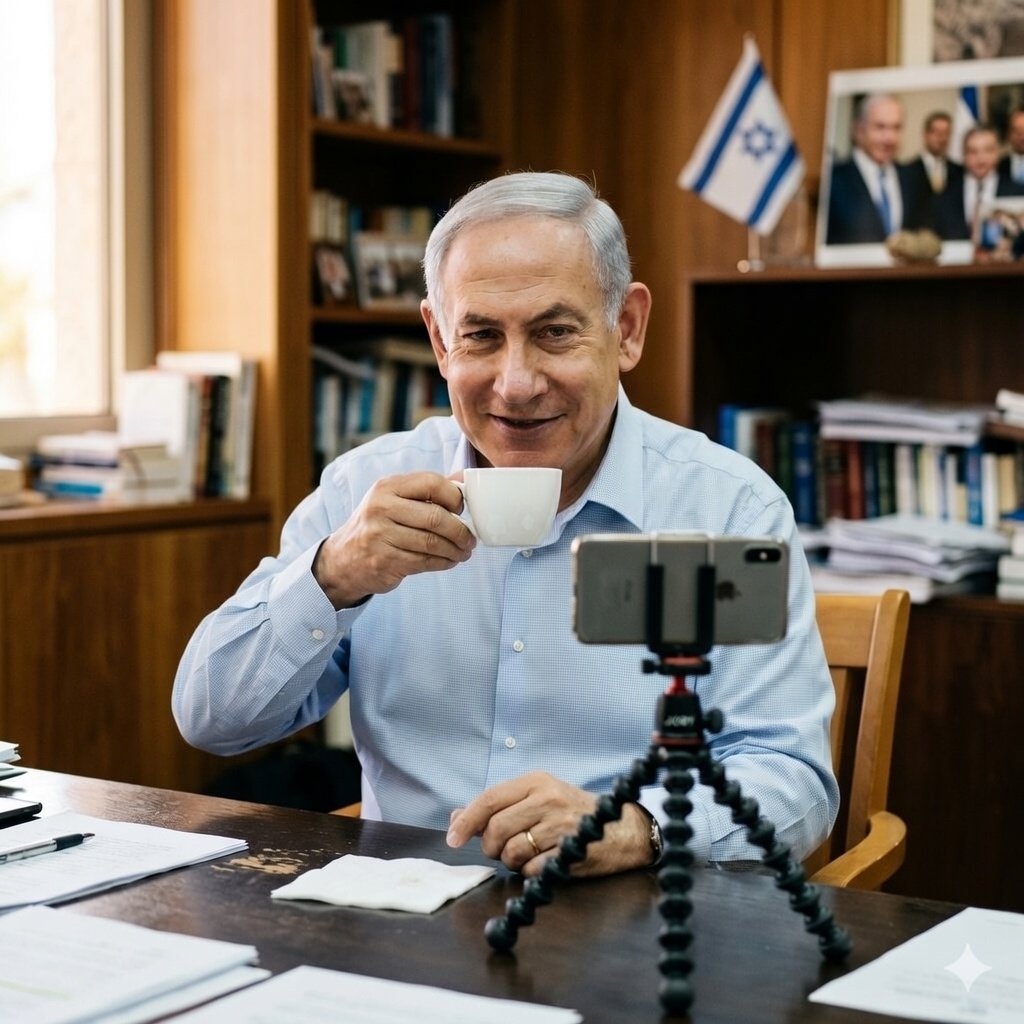
The Jerusalem Post’s analysis was precise: the piece fits a familiar pattern in Iranian and pro-Iranian information warfare, in which real fragments of public information are stitched together into a dramatic narrative, then circulated as though they point to a hidden event. This tactic is not new. Rumours of Vladimir Putin’s death or incapacitation have circulated during the Ukraine war. Similar hoaxes targeted Volodymyr Zelensky in the early days of the Russian invasion. In each case, the structure was identical: information gaps created by wartime security restrictions are filled with speculation dressed as evidence.
During fast-moving conflicts, the absence of a new video, a vague official statement, or a change in a visiting dignitary’s schedule can become raw material for conspiracy theories. As the conflict between the US, Israel, and Iran intensified through March 2026, the information environment around senior leaders became increasingly charged making it easier for fabricated claims to find audiences ready to believe them.
FALSE. There is no evidence of any Iranian strike targeting Netanyahu’s person, residence, or convoy. Xinhua reported on March 2 that residents near Netanyahu’s office in Jerusalem saw no signs of a missile impact. The PMO confirmed he met senior officials in Tel Aviv on March 1. He made documented public appearances on March 6, 7, 10, and 12. On March 15, he appeared on video in good health. Snopes formally rated this claim false on March 12 after his live press conference broadcast.
FALSE. After Netanyahu posted a video on X on March 14 discussing the conflict, some users claimed to notice what appeared to be six fingers on his right hand alleging the video was artificially generated using AI. Digital analysts reviewed the footage and reached a consistent conclusion: the supposed sixth finger was a visual illusion caused by camera angle, shadows, lighting,
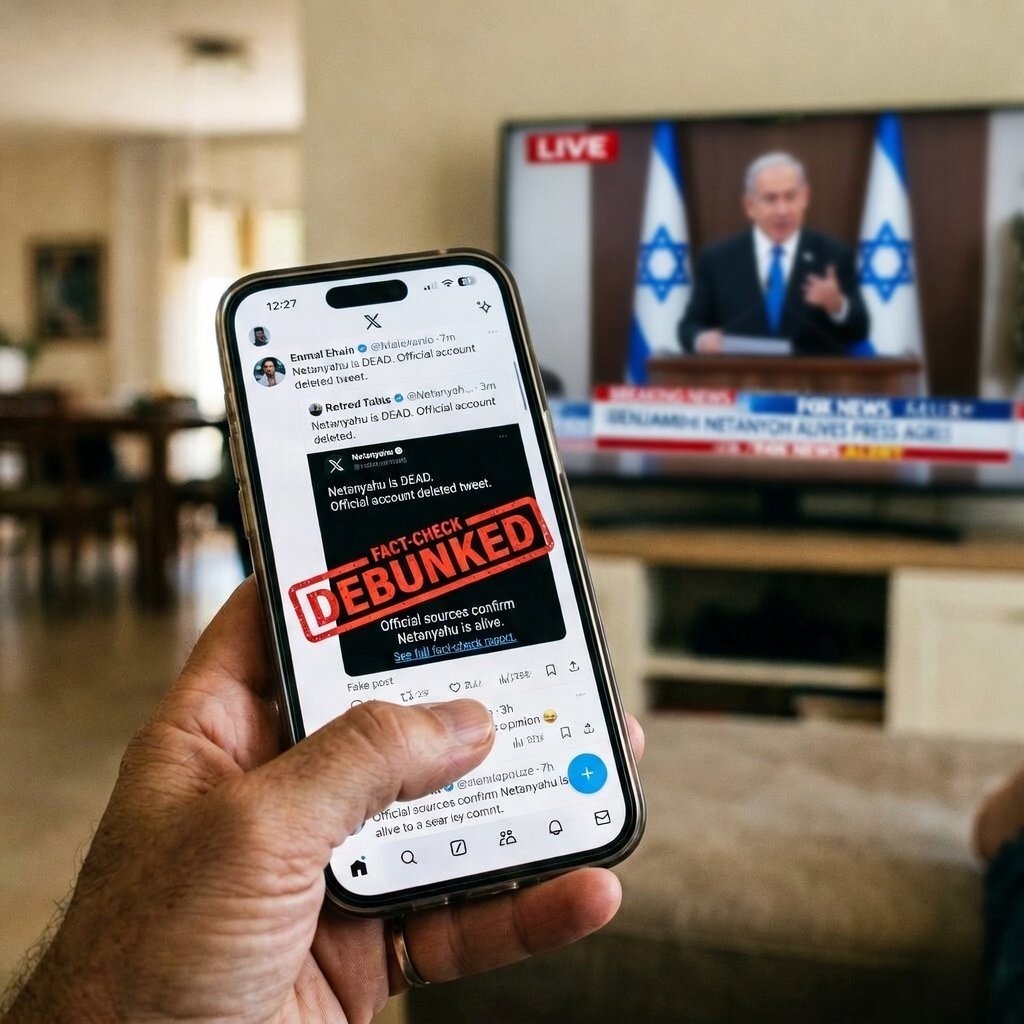
and the natural contour of the palm’s hypothenar eminence (the fleshy pad on the outer edge of the hand). Grok, X’s AI chatbot, explicitly addressed the claim: the full, unedited footage released by Israel’s Government Press Office clearly showed Netanyahu with the normal five fingers on each hand. Snopes, the Times of Israel, and WION all confirmed the debunk.
Additionally, some users pointed to the moving curtain behind Netanyahu in the video as evidence of a looping digital background. Digital analysts found no evidence to support this interpretation curtain movement in broadcast footage is a common result of air conditioning or camera movement, not evidence of digital manipulation.
FALSE. This claim circulated widely in the early days of the conflict. The PMO directly addressed it: Netanyahu met Israel’s Defence Minister, IDF Chief of Staff, and Mossad Director in Tel Aviv on March 1. He appeared in Beersheba on March 6, visiting an impact site. He was at the National Health Command Center on March 10 and at Ashdod Port the same day. There is no evidence he left Israel at any point during this period.
UNSUBSTANTIATED. Netanyahu’s son Yair did not post on X for several days, which some users interpreted as evidence that something terrible had happened to his father. There is no evidence linking Yair Netanyahu’s social media absence to any harm to the Prime Minister. People refrain from posting on social media for many reasons, including during wartime security protocols or at family or legal counsel. Absence of activity on a personal account is not evidence of a national emergency.
FALSE and SPECULATIVE. Online commentators including political commentator Johannes M. Koenraadt argued that US Treasury Secretary Scott Bessent appeared visibly shaken after returning to a press conference from a phone call, suggesting he had learned of Netanyahu’s death. This is pure inference with no evidential basis. Senior government officials receive phone calls during press conferences for numerous reasons. Bessent’s demeanour, whatever its cause, does not constitute evidence about Netanyahu’s health or survival.
The most powerful rebuttal to any death claim is a documented public timeline. Netanyahu’s verified activity in March 2026, drawn exclusively from official Israeli government sources:

This is not a leader who has gone dark. This is a leader with a fully documented public record across 14 consecutive days of wartime activity.
The Netanyahu death hoax is not an isolated incident. During the Israel-Iran conflict, similar false claims have targeted Mojtaba Khamenei’s condition, Iran’s chain of command, and the status of various military assets. The pattern will continue as long as the conflict does. Fact-checking organisations including Snopes and the Jerusalem Post have urged the public to apply a consistent standard before sharing any dramatic claim about a leader’s death or injury: wait for official confirmation from the leader’s own office or government, look for live video from verified accounts, cross-reference against established newswires (AP, Reuters), and treat Iranian state media claims about Israeli leaders and Israeli state media claims about Iranian leaders with appropriate scepticism.
Grok summarised the appropriate standard succinctly: ‘Netanyahu is alive; death rumors from Iranian media and social posts have been debunked by Snopes, Times of Israel, and others. Rely on official verified sources.’
The answer to ‘Is Netanyahu alive in 2026?’ is straightforward: yes, definitively, confirmed, and documented. His office called the claims ‘fake news.’ Snopes rated them false. The Jerusalem Post identified their IRGC-linked origin. And Netanyahu himself appeared on video laughing about them over a cup of coffee.
However, the more important story is not the debunk. It is the architecture of the deception. Tasnim News Agency assembled real public fragments a delayed visit, a vague diplomatic readout, a few quiet days on social media and constructed a false narrative designed to circulate in the chaos of an active war. It worked, briefly and imperfectly, because the information environment of modern conflict is designed to amplify doubt faster than certainty can travel.
Consequently, in an era when a wartime death hoax can cross 50 countries in 48 hours, the fact-check is not just a journalistic service. It is an act of informational defence. Benjamin Netanyahu is alive. The rumour that he was not is a case study in how coordinated misinformation operates and why sourced, verified journalism matters more in a war than at any other time.


 Optimized by Seraphinite Accelerator