Global War Crisis 2026: Middle East Conflict Spreads to Europe & America
monday, March 30, 2026 Trusted by millions worldwide Back to News Politics Global War Crisis 2026: Middle East Conflict Spreads...
Read More → 

Sunday, March 29, 2026
Trusted by millions worldwide
Binance has been fined in Australia and this time, the details are damning. On March 27, 2026, Australia’s Federal Court imposed an AUD $10 million penalty (approximately USD $6.9
Binance fined Australia 2026 Binance Australia Derivatives, trading as Oztures Trading Pty Ltd, for systematically misclassifying retail investors as professional clients and exposing them to high-risk derivative products without the consumer protections required by Australian law. The ruling adds a fresh chapter to Binance’s lengthy global compliance record and signals that regulators worldwide are moving decisively from warnings to enforcement.
Binance fined Australia 2026 Between July 2022 and April 2023, Binance Australia Derivatives ran a client onboarding process that the Federal Court found to be fundamentally broken. Australia’s securities regulator, ASIC (Australian Securities and Investments Commission), sued the company in late 2024 and the court’s findings were unambiguous.
A total of 524 retail investors were wrongly classified as wholesale clients a designation under Australian law reserved for high-net-worth, experienced, or professional investors. This misclassification gave them access to complex leveraged derivatives products they were legally never supposed to be offered. Justice Moshinsky found that more than 85% of Binance Australia’s entire customer base fell into this misclassified group.
The Australia ruling does not exist in isolation. It is the latest entry in a catalogue of enforcement actions across multiple continents:
| Year | Jurisdiction | Fine / Action | Key Issue |
|---|---|---|---|
| 2022 | Netherlands | €3.3 million | Operating without local registration |
| 2023 | USA (DOJ/CFTC) | $4.3 billion | Money laundering, sanctions violations, BSA breaches — largest US Treasury penalty ever |
| 2024 | Canada | CAD $4.32M | AML / terrorist financing violations |
| 2024 | India | $2.25 million | Operating in violation of AML regulations |
| 2024 | Nigeria | Exec detention + $81.5B lawsuit | Money laundering allegations — $79.5B in damages still being pursued |
| 2025 | France | Under investigation | Money laundering, drug trafficking, tax fraud probe |
| 2026 | Australia | $6.9M (USD) | Misclassifying 85%+ retail clients as wholesale investors |
The consequences for misclassified investors were severe. The court found that the 524 retail investors collectively suffered AUD $8.66 million in trading losses and paid a further AUD $3.89 million in fees during the misclassification period a combined financial harm exceeding AUD $12.5 million.
These were ordinary retail investors, not sophisticated traders. They were placed, without proper protections, into a high-risk derivatives market they were legally never supposed to access.
Notably, Binance had already paid approximately AUD $13.1 million in direct compensation to affected clients in 2023, after self-identifying the problem before ASIC’s formal enforcement action concluded. The AUD $10 million court penalty comes on top of that earlier remediation.
The most striking finding: Binance used a multiple-choice ‘Sophisticated Investor Test’ to determine whether customers qualified as wholesale investors — and then allowed users to retake the test an unlimited number of times until they passed.
The test was supposed to be a gatekeeping mechanism. In practice, it was a formality that any persistent user could eventually clear regardless of their actual financial knowledge or sophistication. In one example cited by the court, Binance approved a client as a professional investor based solely on that person’s self-declaration that they were an ‘exempt public authority’ — with no independent verification whatsoever.
Binance’s response was measured. In a statement, the company said the issue had been ‘self-identified, reported to ASIC, and fully remediated in 2023.’ The entity responsible — Oztures Trading — voluntarily surrendered its Australian Financial Services Licence (AFSL) the same year, and the derivatives business has ceased operations entirely.
Binance Australia continues to operate for spot trading. A company spokesperson told Decrypt the issues arose in ‘a specific business unit that no longer exists,’ and that Binance Australia remains ‘committed to offering users innovative, compliant, and trusted products.’
Whether those assurances satisfy regulators and investors is a different question — and Australia is far from Binance’s only open file.
BNB Binance’s native token fell sharply on news of the ruling before partially recovering, continuing a now-familiar pattern. Crypto markets are increasingly capable of pricing in Binance regulatory risk, but they are never fully immune to new enforcement headlines.
More significantly, the ASIC ruling signals an accelerating global shift from passive oversight to active enforcement particularly in retail investor protection. The court’s criticism was specific: broken onboarding processes, investor classification tests that anyone could pass indefinitely, inadequate risk disclosures, and insufficient staff training.
For competing exchanges, this represents both a warning and an opportunity. Platforms that have invested in compliance infrastructure can point to Binance Australia as proof that regulatory shortcuts carry real legal and reputational costs.
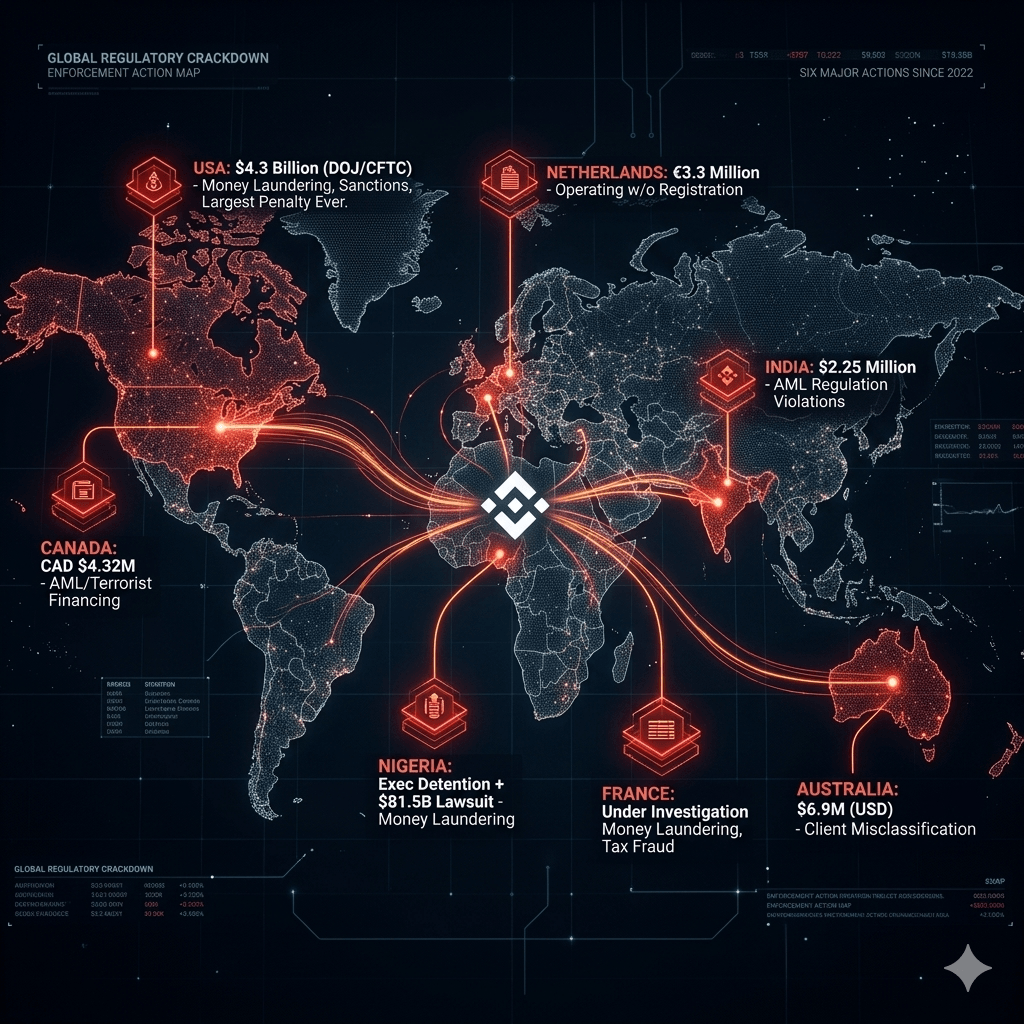
The Australian chapter may be closed, but several others remain wide open. Nigeria’s Federal Inland Revenue Service is pursuing Binance for USD $79.5 billion in economic damages and USD $2 billion in back taxes an action that, if it reaches judgment, would dwarf every previous regulatory penalty combined.
French authorities opened a formal judicial investigation in January 2025 covering potential money laundering, drug trafficking, and tax fraud between 2019 and 2024. US DOJ monitoring under the 2023 compliance agreement remains live.
CEO Richard Teng continues to emphasise a compliance-first culture a formal board of directors has been appointed, compliance staffing has expanded, and UAE sovereign wealth fund Mubadala acquired a USD $2 billion stake in 2025. These are genuine structural changes. The defining question of 2026 is whether they are enough to satisfy regulators globally and whether Binance’s pardoned founder paves the way for a return to the US market.
Why was Binance fined in Australia in 2026?
Australia’s Federal Court fined Binance Australia Derivatives AUD $10 million (USD $6.9 million) for misclassifying 524 retail investors as wholesale clients between July 2022 and April 2023. This gave retail investors access to high-risk derivative products they were legally not supposed to access, resulting in combined losses and fees exceeding AUD $12.5 million.
Is Binance still legal in Australia in 2026?
Binance Australia remains operational for spot cryptocurrency trading. The derivatives arm Oztures Trading Pty Ltd voluntarily surrendered its Australian Financial Services Licence in 2023 and has ceased operations. Only the derivatives business was the subject of the ASIC enforcement action.
How much has Binance been fined in total globally?
Including the 2023 US DOJ settlement of $4.3 billion, various multi-million dollar fines across the Netherlands, Canada, India, and Australia, and ongoing lawsuits in Nigeria and France, Binance’s total global regulatory exposure runs into the billions of dollars making it the most heavily regulated cryptocurrency exchange in history.
What happened to Binance’s founder CZ after the US case?
Changpeng ‘CZ’ Zhao pleaded guilty to money laundering violations in the landmark 2023 US settlement, stepped down as CEO, and served four months in prison before being released in September 2024. He received a full presidential pardon from Donald Trump in October 2025. Richard Teng now leads Binance as CEO.
The Binance Australia fine of USD $6.9 million matters less for its size than for what it represents: another court, another regulator, another finding that Binance’s compliance systems failed ordinary retail investors. The 524 Australians who were misclassified and lost millions are not statistics they are the real-world cost of a compliance culture that Binance’s leadership insists is now reformed.


 Optimized by Seraphinite Accelerator